

Age in the 2025 Minnesota Legislature
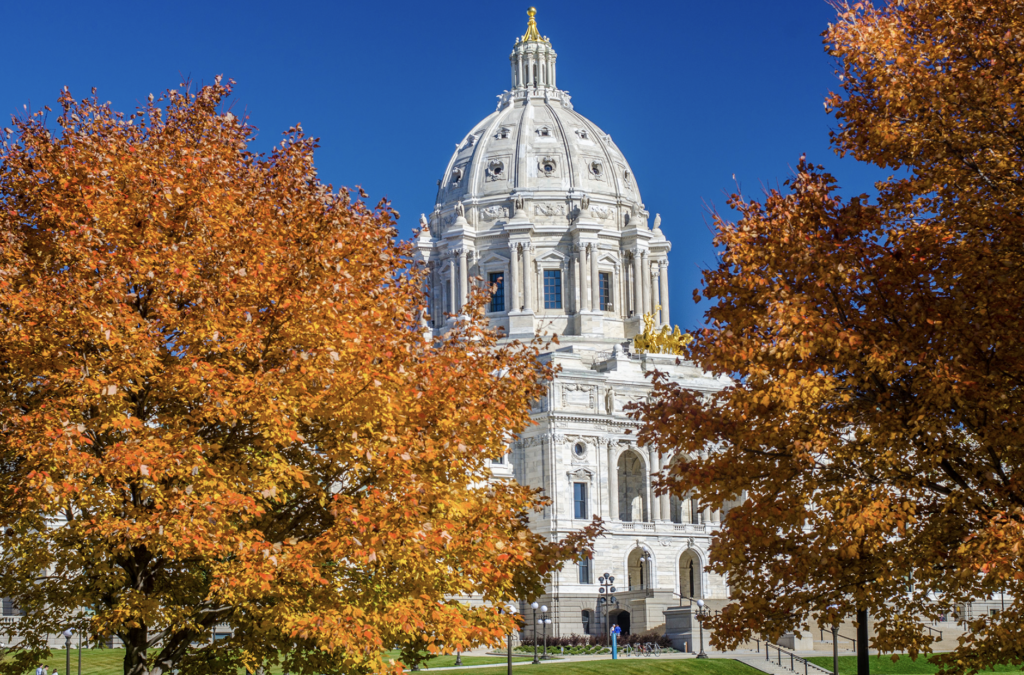
The State of Minnesota held its elections for a new Minnesota House of Representatives and Minnesota State Senate on November 4th 2024. In January 2025 the currently active 94th legislative session of the Minnesota State Legislature. Among the members elected 24 were aged 35 or younger on election day in 2024. Below is a map of these representatives within both chambers of the Minnesota State Legislature.
Minnesota Demographic Background in the 2024 Election
Preliminary estimates from CIRCLE at Tufts University indicate that 42% of young people aged 18–29 voted in the 2024 election, with turnout surpassing 50% in key battleground states. Nearly 50 million young citizens were eligible to vote nationwide, including over 8 million who turned 18 since the 2022 midterms.
According to the Pew Research Center, Millennials surpassed Baby Boomers in 2020 to become the largest generation in the U.S., making up 31% of the population, followed closely by Boomers at 30.9%. Generation X accounts for 28%, while the Silent Generation makes up just 9.9%. In Minnesota, young voters played an outsized role in shaping both state and national outcomes. The state ranked sixth on CIRCLE’s Youth Electoral Significance Index (YESI) for projected youth impact in the 2024 presidential race. Minnesota’s 2nd Congressional District was also among the top YESI-rated contests, ranking 15th nationwide.
Minnesota has a strong record of youth political engagement, maintaining one of the highest youth voter registration rates in the country. The state’s voter-friendly policies—automatic, online, and same-day registration—make participation especially accessible. Favorable socioeconomic conditions, including a high median household income and low unemployment, also support strong turnout. Importantly, young Minnesotans tend to vote differently from older adults, giving them the potential to influence outcomes in a state projected to be competitive in presidential elections. (YESI-2024 Presidential Impacts).
The Minnesota House of Representatives 94th Legislative Session
Below is information covering age dynamics in the recently elected to the Minnesota House of Representatives
- the average age of Minnesota House of Representatives members is 49.67 years
- the youngest Representative Elliott Engen was born in 1998
- the oldest Representative Paul H. Anderson was born in 1951
- 15 Representatives are Young Elected Leaders age 35 or younger as of Election Day 2024
Generational Breakdown
Within the Minnesota House of Representatives, most representatives come from the Millennial, Generation X or The Baby Boomer generation. Importantly, only a one member of the current Minnesota House of Representatives belongs to Generation Z. Scroll below to see the generations in the Minnesota House of Representatives visualized.
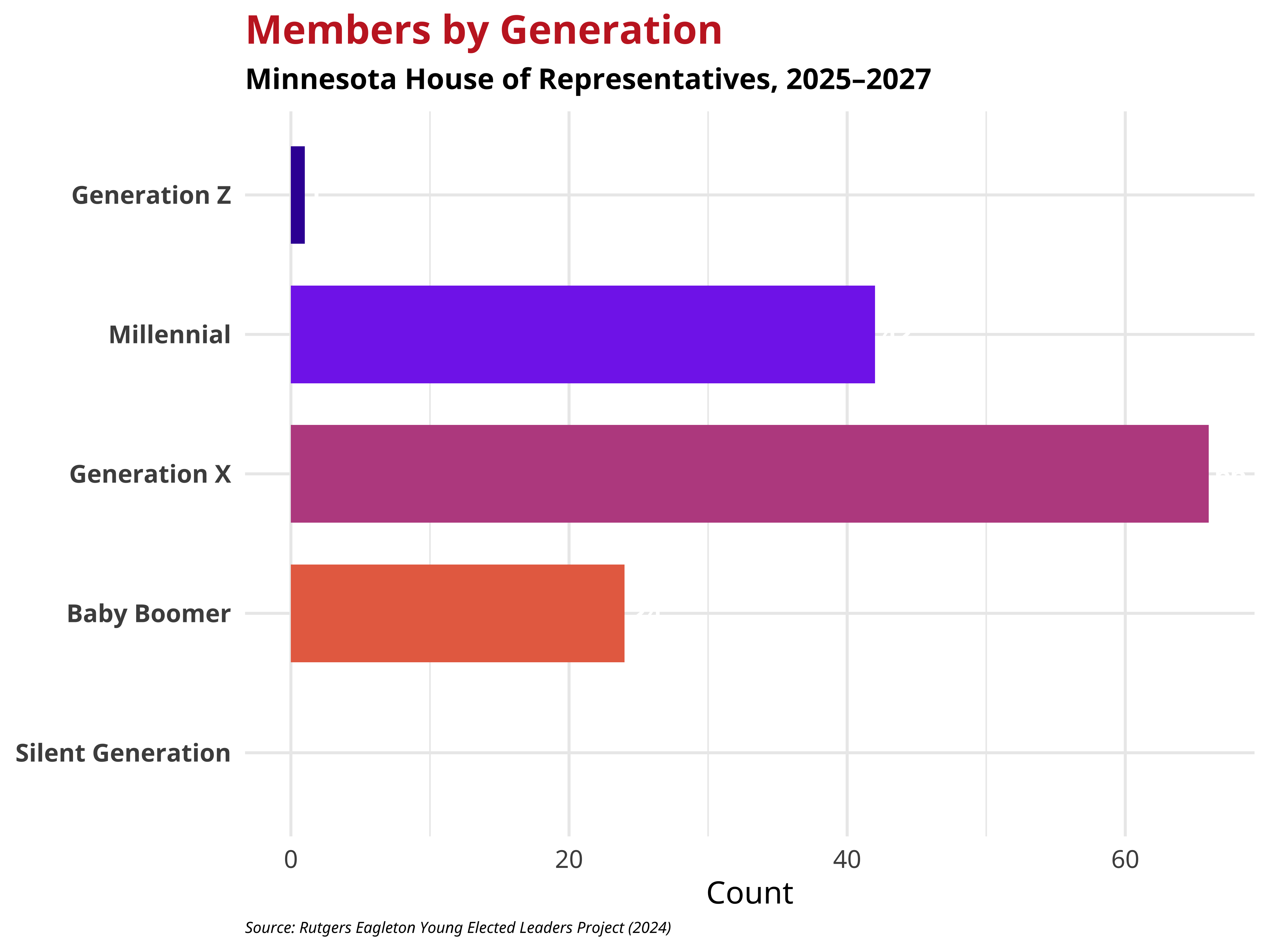
* One house seat is currently vacant
Partisanship in the Minnesota House of Representatives
The chart below further breaks down the current partisan makeup of the 2025 Minnesota House of Representatives. Each dot represents a single member, colored by both party affiliation and whether the legislator qualifies as a Young Elected Leader (YEL)—defined as age 35 or younger at the time of the election. This format provides a visual snapshot of generational and partisan distribution within the chamber, highlighting how younger legislators are positioned across party lines.
Partisan differences in the Minnesota House of Representatives extend beyond ideology to include notable generational contrasts. As shown in the visual below, Republican legislators have a higher average age than their Democratic counterparts—52.07 years compared to 47.22 years—a gap of 4.85 years. These disparities may reflect broader patterns in political recruitment, generational turnover, and the types of candidates emerging in recent election cycles.
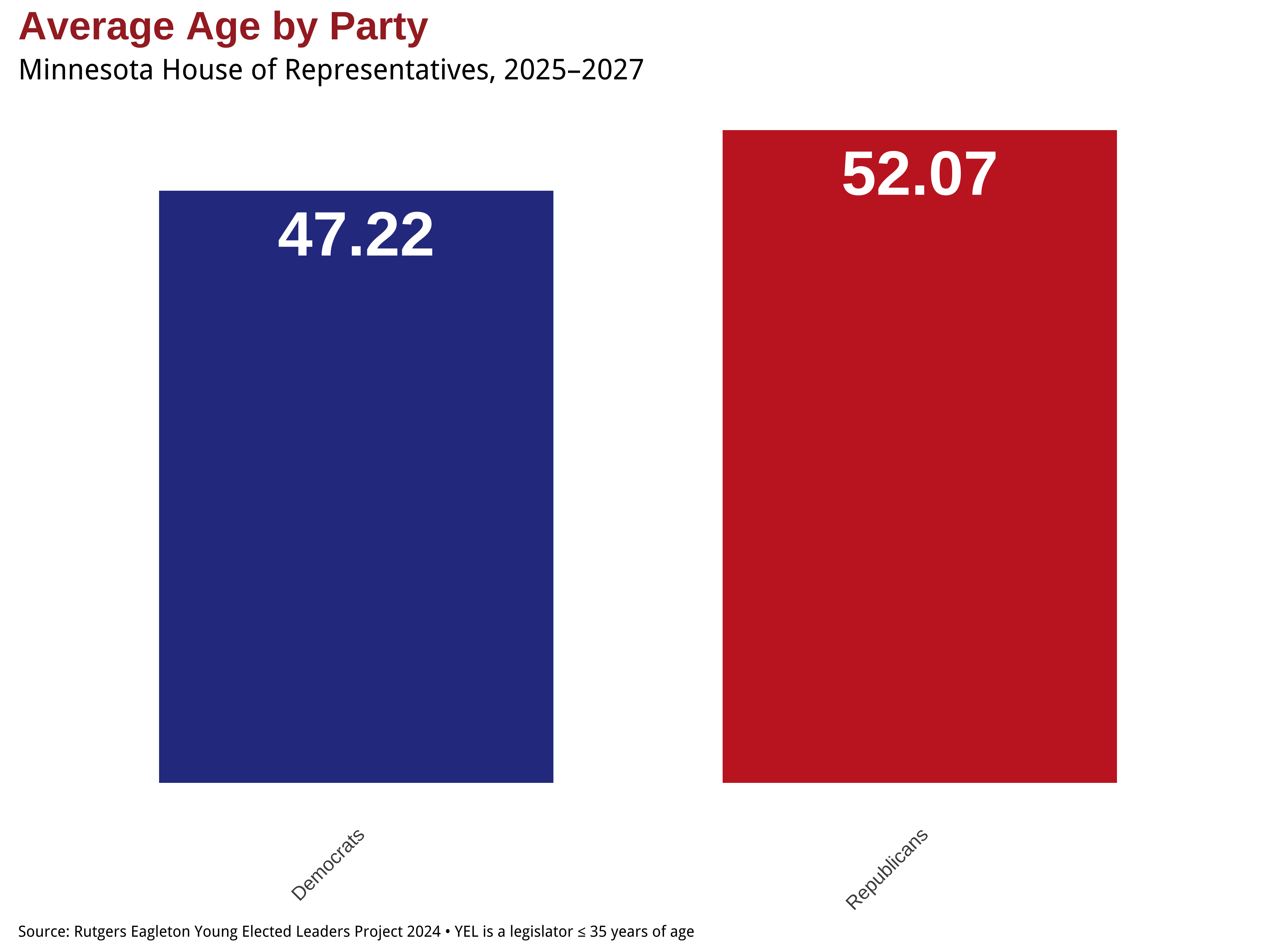
* One house seat is currently vacant
Young Elected Representatives – Minnesota House of Representatives
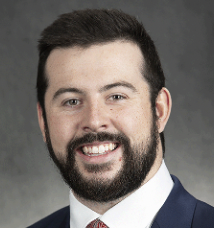
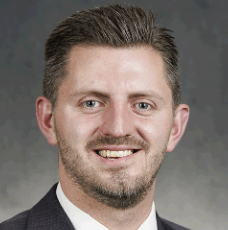
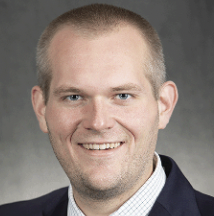
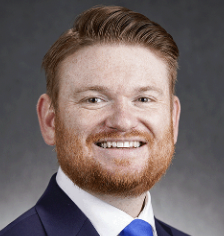
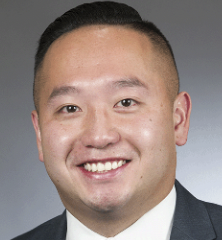
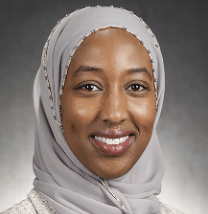
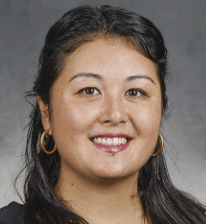
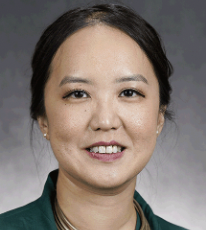
Following the 2024 State Legislative Elections in Minnesota, fifteen members aged 35 or under were elected to the Minnesota House of Representatives. Below are all fifteen of these members, ordered from youngest to oldest, along with information about their local districts and party affiliation.
| Name | District | Birth year (Age on Election Day) | Year first elected to Minnesota House | |
|---|---|---|---|---|
 |
Elliott Engen (R) | District 36A –
White Bear Lake, MN |
1998 (Age 26) | 2022 |
 |
Spencer R. Igo (R) | District 7A –
Grand Rapids, MN |
1996 (Age 28) | 2020 |
 |
Samantha Vang (DFL) | District 38B –
Brooklyn Center, MN |
1994 (Age 30) | 2018 |
 |
Isaac M. Schultz (R) | District 10B –
Upsala, MN |
1991 (Age 33) | 2022 |
 |
Bjorn Olson (R) | District 22A –
Elmore, MN |
1991 (Age 33) | 2020 |
 |
Andrew Smith (DFL) | District 25B –
Rochester, MN |
1991 (Age 33) | 2022 |
 |
Max Rymer (R) | District 28B –
Edina, MN |
1991 (Age 33) | 2024 |
 |
Fue Lee (DFL) | District 59A –
Minneapolis, MN |
1991 (Age 33) | 2016 |
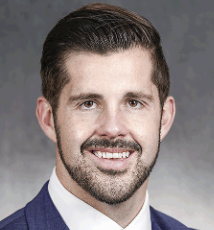 |
Dan Wolgamott (DFL) | District 14B –
St. Cloud, MN |
1990 (Age 34) | 2018 |
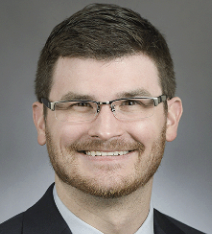 |
Nolan West (R) | District 32A –
Blaine, MN |
1990 (Age 34) | 2016 |
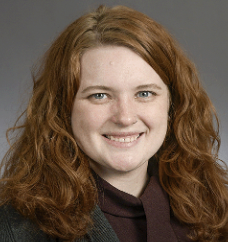 |
Sydney Jordan (DFL) | District 60A –
Minneapolis, MN |
1990 (Age 34) | 2020 |
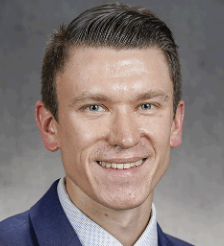 |
Matt Norris (DFL) | District 32B –
Blaine, MN |
1988 (Age 35) | 2022 |
 |
Anquam Mahamoud (DFL) | District 62B –
Saint Paul, MN |
1989 (Age 35) | 2024 |
 |
Samantha Sencer-Mura (DFL) | District 63A –
Minneapolis, MN |
1989 (Age 35) | 2022 |
 |
Liz Lee (DFL) | District 67A –
Coon Rapids, MN |
1989 (Age 35) | 2022 |
Photos courtesy of the Minnesota House of Representatives member roster.
Gender in the Minnesota House of Representatives
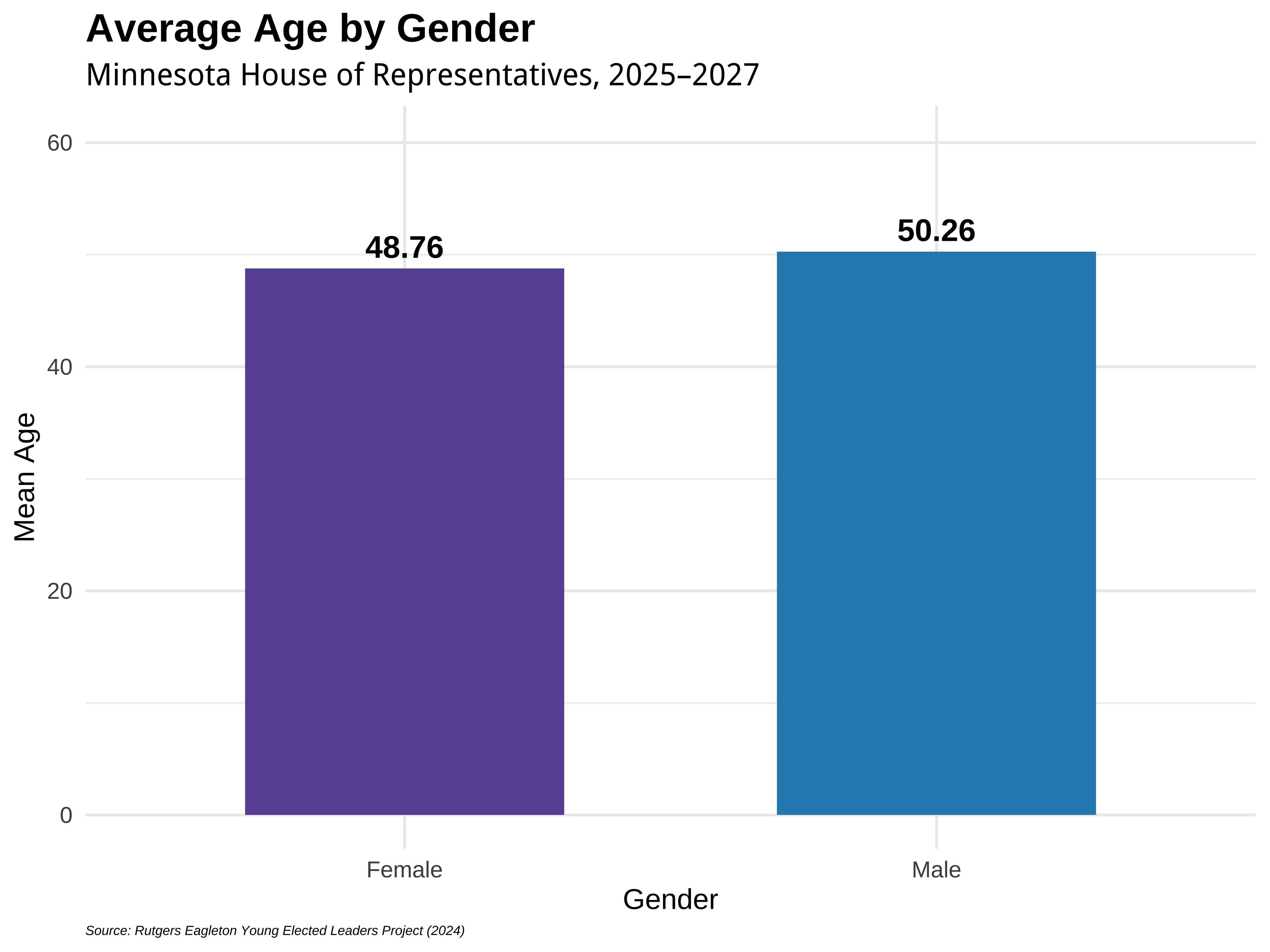
The Minnesota House of Representatives reflects a range of age and gender dynamics that help shape the composition of the state’s legislative body. Across all members, 60.15% are men, while women make up 39.85%. Men have a higher mean age than women with the current Minnesota House. For male representatives there was an average age of 50.26 at the time of the election, compared to 48.76 for their female colleagues. Of the the 15 Young Elected Leaders, 10 are male and 5 are female.
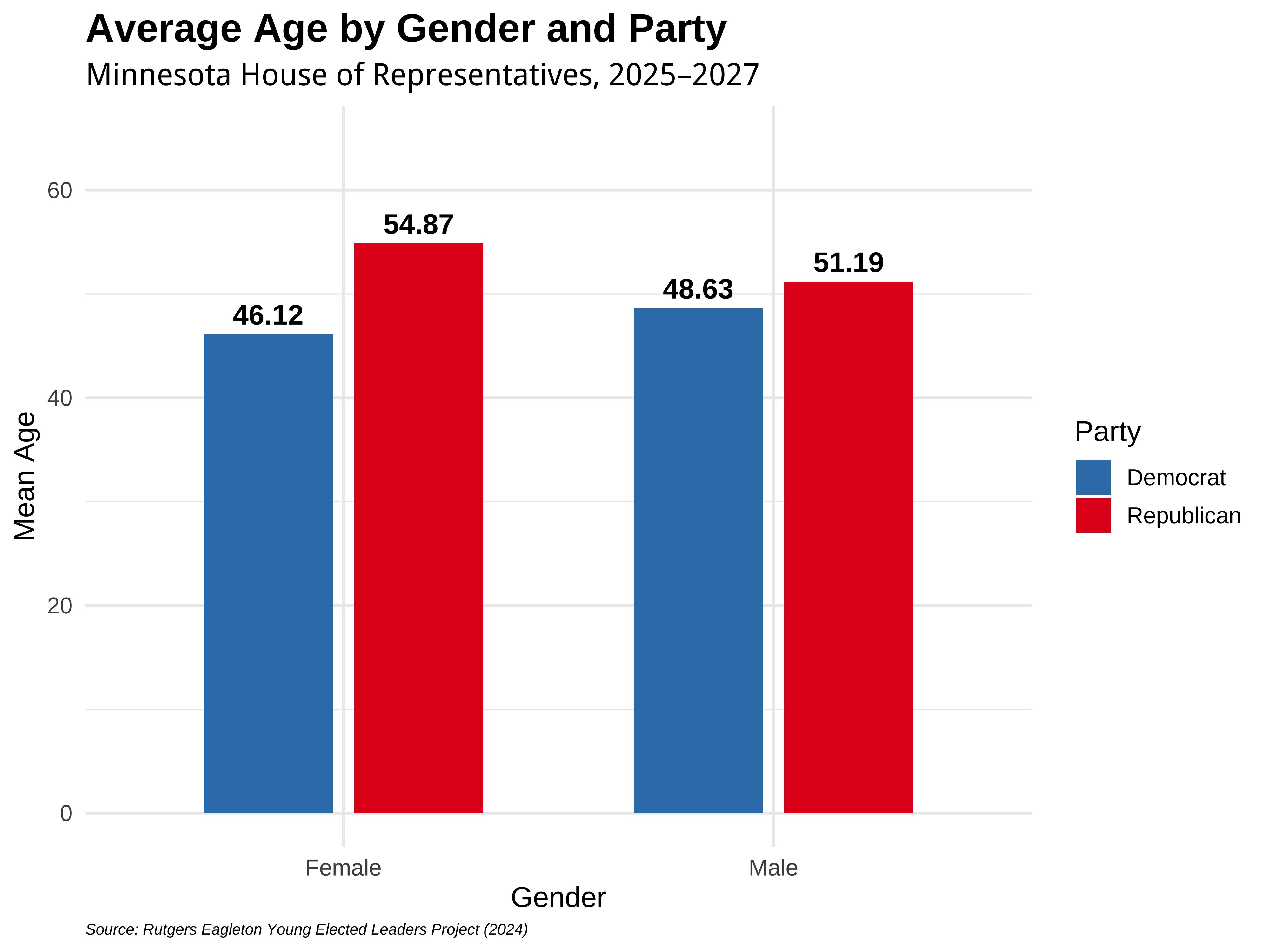
When examining both gender and party affiliation, additional differences in age emerge within the Minnesota House of Representatives. Democratic women have the lowest average age of all four groups at 46.12, while Democratic men have a higher average age of 48.63. For Republicans in the Minnesota House of Representatives, men and women are on average older, with Republican men averaging 51.19 and Republican women averaging the highest age among these groups at 54.87. These patterns show that age representation in the Minnesota House of Representatives varies by both gender and partisan alignment, highlighting differing pathways to political office across demographic groups.
* One house seat is currently vacant
Race and Ethnicity in the Minnesota House of Representatives
The racial and ethnic composition of the Minnesota House varies across generations. In 2024, younger cohorts show more diversity, though the chamber overall remains majority White. The table below shows each generation’s distribution.
Generations by Race/Ethnicity in the Minnesota House of Representatives
| Ethnicity | Generation Z 1997 – |
Millennial Generation 1981 – 1996 |
Generation X 1965 – 1980 |
Boomer Generation 1946 – 1964 |
Full Chamber |
|---|---|---|---|---|---|
| White/Caucasian | 1 (100%) | 30 (71.43%) | 57 (86.36%) | 23 (95.83%) | 111 (83.46%) |
| Asian/Pacific American | – | 4 (9.52%) | 3 (4.55%) | – | 7 (5.26%) |
| Black/African American | – | 3 (7.14%) | 3 (4.55%) | 1 (4.17%) | 7 (5.26%) |
| Hispanic/Latino | – | 1 (2.38%) | 2 (3.03%) | – | 3 (2.26%) |
| Two or More Ethnicities | – | 3 (7.14%) | – | – | 3 (2.26%) |
| Other | – | 1 (2.38%) | 1 (1.52%) | – | 2 (1.5%) |
| Total | 1 (0.75%) | 42 (31.58%) | 66 (49.62%) | 24 (18.05%) | 133 (100%) |
* One House seat is currently vacant. The full Minnesota House of Representatives is comprised of 134 seats.
The Minnesota Senate
Below is information covering age dynamics in the recently elected Minnesota State Senate.
- the average age of Minnesota State Senate members is 54.09 years
- the youngest Senator is Zaynab Mohamed who was born in 1997
- the oldest Senator is Ann H. Rest who was born in 1942
- 9 members of the Minnesota State Senate are Young Elected Leaders, aged 35 or younger as of Election Day 2024
Young Elected Senators in the Minnesota State Senate
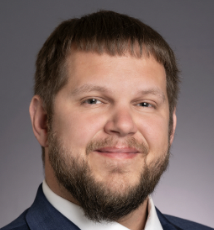
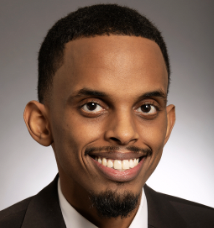
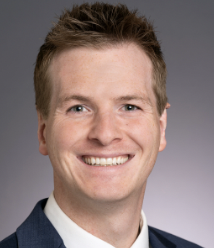
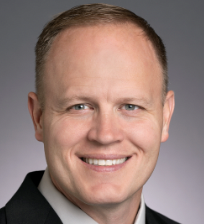
Following the 2024 State Legislative Elections in Minnesota, nine members aged 35 or under were elected to (and currently serve in) the Minnesota State Senate. Below is information about their local districts and party affiliation.
| Name | District | Birth Year (Age on Election Day) | Year First Elected to the Minnesota State Senate | |
|---|---|---|---|---|
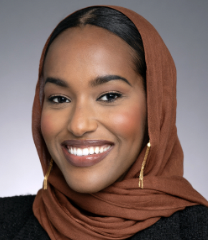 |
Zaynab Mohamed (DFL) | 63rd District –
Minneapolis, MN |
1997 (Age 27) | 2022 |
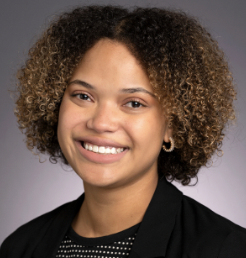 |
Clare Oumou Verbeten (DFL) | 66th District –
Saint Paul, MN |
1995 (Age 29) | 2022 |
 |
Jordan Rasmusson (R) | 9th District –
Fergus Falls, MN |
1993 (Age 31) | 2022 |
 |
Julia E. Coleman (R) | 48th District –
Chanhassen, MN |
1991 (Age 33) | 2020 |
 |
Tou Xiong (DFL) | 44th District –
Maplewood, MN |
1990 (Age 34) | 2022 |
 |
William Lieske (R) | 58th District –
Lonsdale, MN |
1990 (Age 34) | 2022 |
 |
Omar M. Fateh (DFL) | 62nd District –
Minneapolis, MN |
1990 (Age 34) | 2020 |
 |
Grant D. Hauschild (DFL) | 3rd District –
Hermantown, MN |
1989 (Age 35) | 2022 |
 |
Robert D. Farnsworth (R) | 7th District – Hibbing, MN | 1989 (Age 35) | 2022 |
Photos courtesy of the Minnesota State Senate member roster.
Partisanship in the Minnesota State Senate
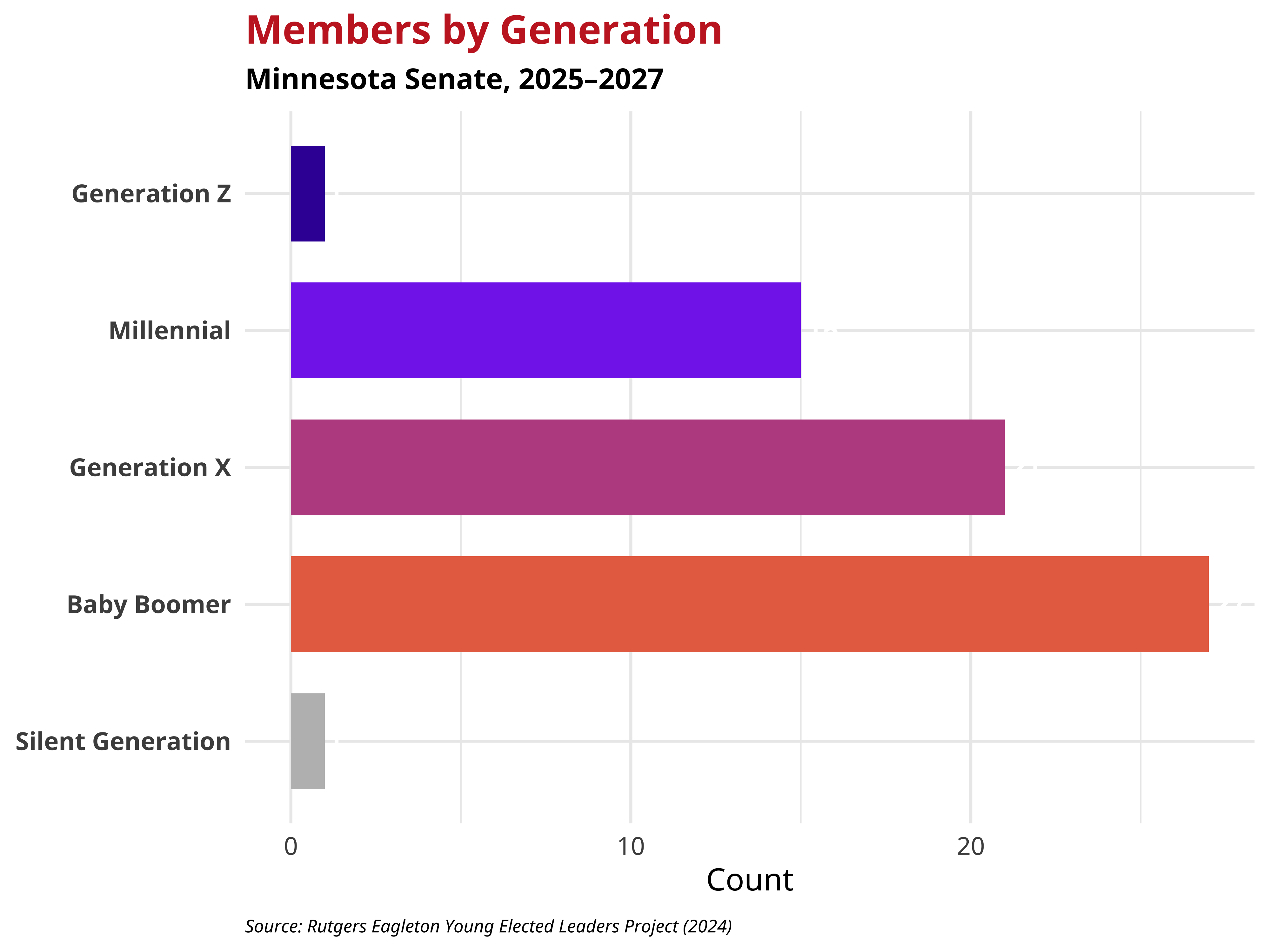
In the Minnesota State Senate, 33 senators belong to the Democratic Party, 32 senators are Republicans. The mean age of Democratic state senators after the 2024 election was 54.15, while the mean age of Republican state senators was 54.03. Each generation had a different partisan makeup. Below is the breakdown of party composition for each generation within the Minnesota State Senate.
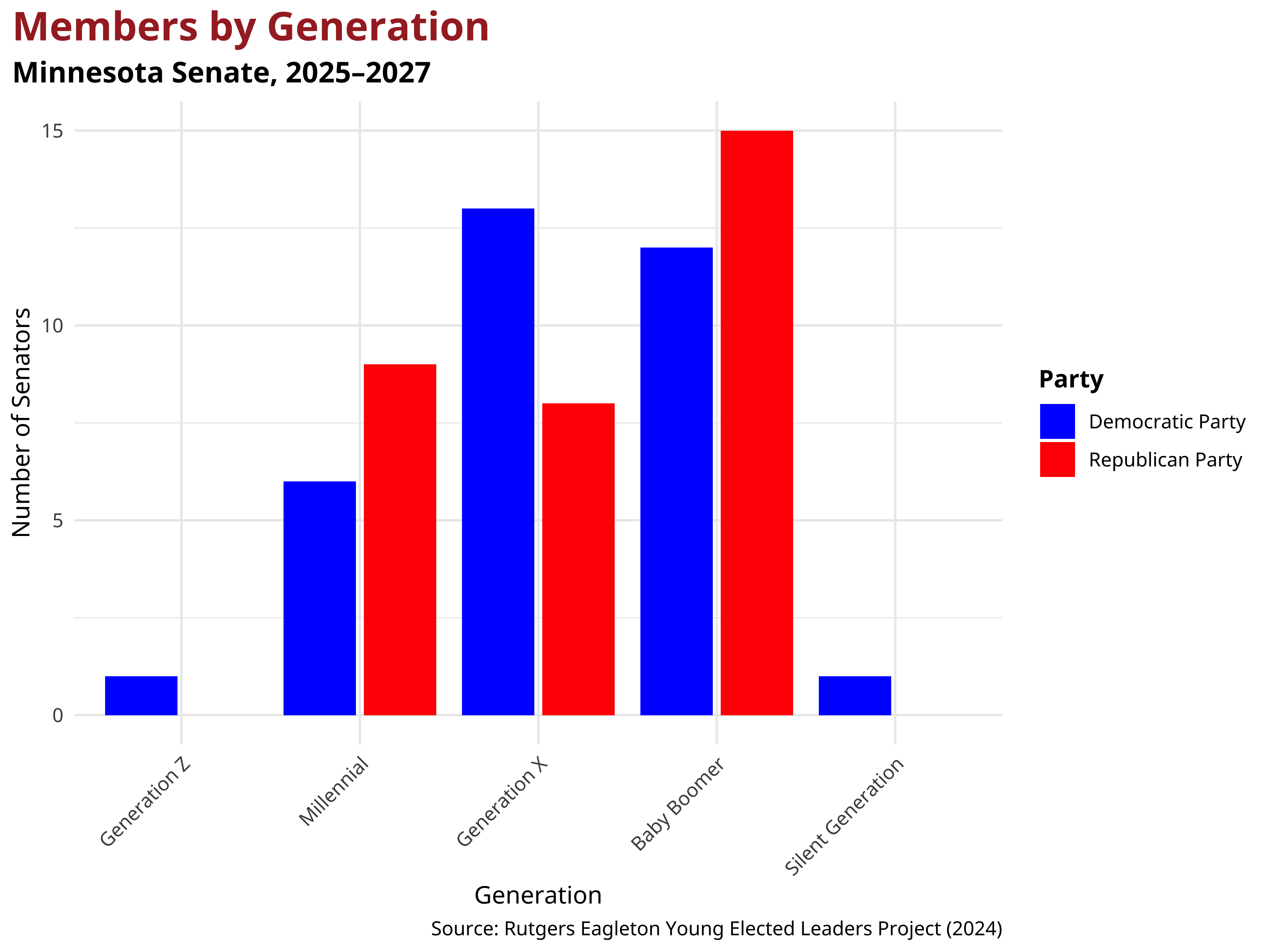
* Two state senate seats currently remain vacant
Gender in the Minnesota Senate
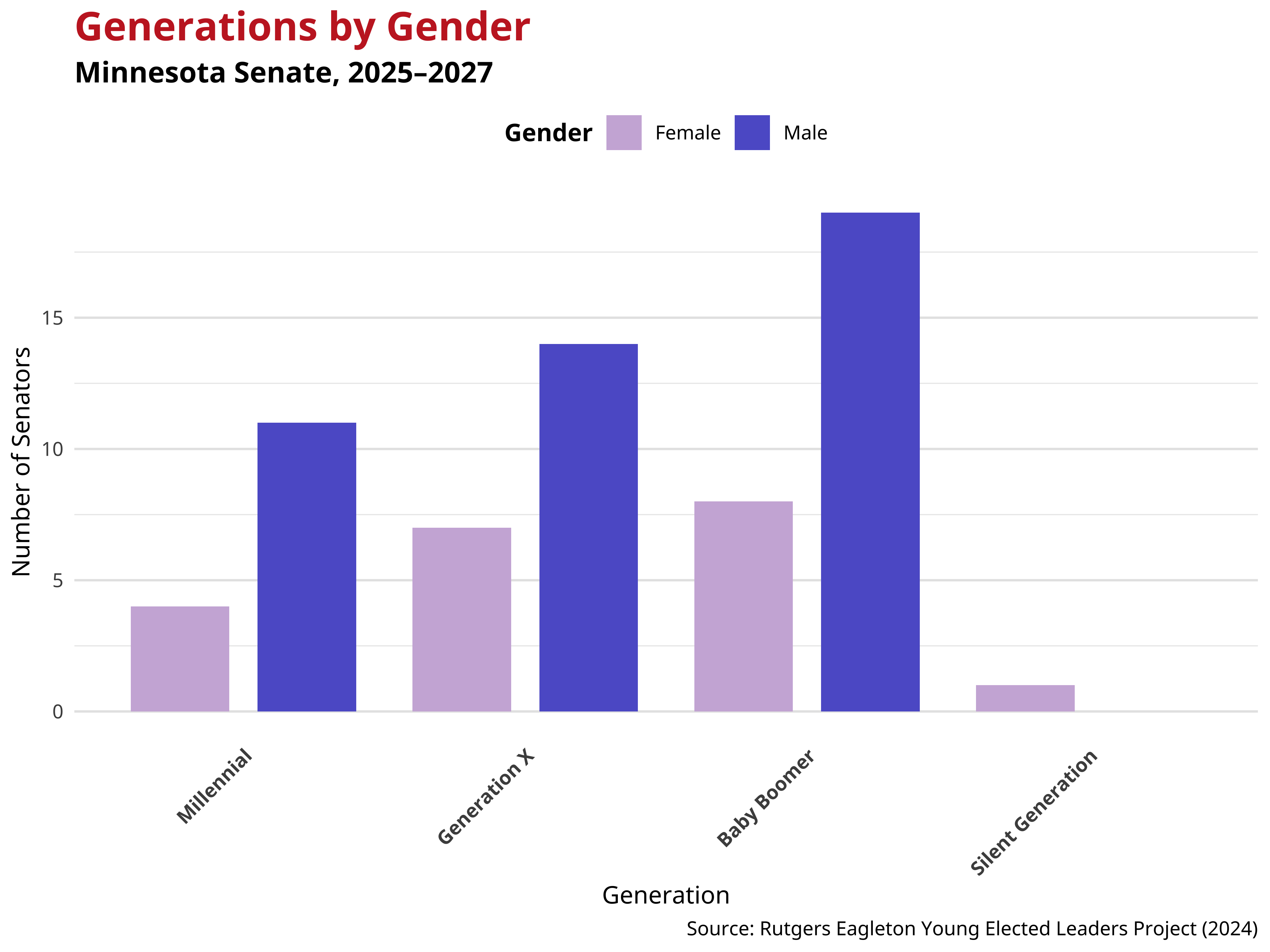
The generational makeup of the Minnesota Senate reveals notable gender dynamics. Overall, men outnumber women, across Millennial, Generation X, and Baby Boomer senators. These patterns indicate that gender representation varies across generations, with women present in every age cohort but often in smaller numbers than men.
Race and Ethnicity in the Minnesota Senate
The racial and ethnic composition of the Minnesota Senate shows generational variation. The table below presents the distribution by generation.
Generations by Race/Ethnicity in the Minnesota State Senate
| Ethnicity | Generation Z | Millennial Generation | Generation X | Boomer Generation | Silent Generation | Full Chamber |
|---|---|---|---|---|---|---|
| White/Caucasian | – | 11 (73.33%) | 17 (80.95%) | 25 (92.59%) | 1 (100%) | 54 (83.08%) |
| Asian/Pacific American | – | 1 (6.67%) | 2 (9.52%) | – | – | 3 (4.62%) |
| Black/African American | – | 1 (6.67%) | – | 1 (3.7%) | – | 2 (3.08%) |
| Hispanic/Latino | – | – | 2 (9.52%) | – | – | 2 (3.08%) |
| Other | 1 (100%) | 1 (6.67%) | – | – | – | 2 (3.08%) |
| Two or More Ethnicities | – | 1 (6.67%) | – | 1 (3.7%) | – | 2 (3.08%) |
| Total | 1 (1.54%) | 15 (23.08%) | 21 (32.31%) | 27 (41.54%) | 1 (1.54%) | 65 (100%) |
* Two Senate seats are currently vacant; the full Minnesota State Senate is comprised of 67 seats.
Notes
The Young Elected Leaders Project applies the generational categorization of the Pew Research Center:
- Silent Generation: 1928 – 1945
- Baby Boomer Generation: 1946 – 1964
- Generation X: 1965 – 1980
- Millennial Generation: 1981 – 1996
- Generation Z: 1997 – 2012
This analysis is based on data from the most recent state legislative election in Minnesota which took place on November 5th 2024.
Citation Guideline
In referencing the Young Elected Leaders Project in publication please use the following language: “The Young Elected Leaders Project is housed at the Center for Youth Political Participation at The Eagleton Institute of Politics, Rutgers University – New Brunswick.”
Bibliographic Citation For this document
Author: Young Elected Leaders Project
Corresponding Authors: George D. Quinn
Year: 2024
Title: Age in the 2025 Minnesota Legislature