

Age in the 2025 Vermont General Assembly
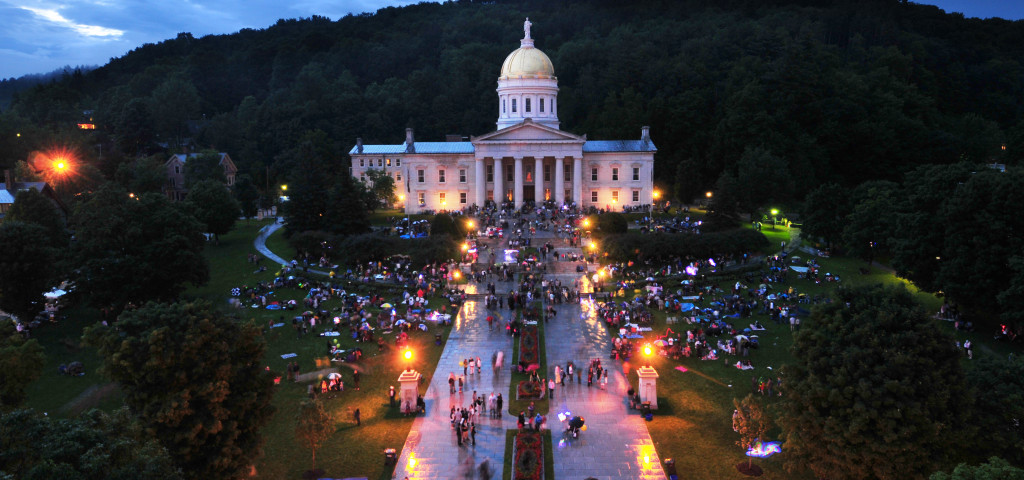
Photo courtesy of the Vermont State Legislature.
The State of Vermont held its elections for the Vermont House of Representatives and Vermont State Senate on November 5, 2024. In January 2025, the Vermont General Assembly officially convened for its 2025-2026 biennial session. Among the members elected, 12 legislators qualify as Young Elected Leaders, defined as those from the Millennial or Gen Z generations (aged 35 or younger on Election Day 2024). Below is a map illustrating the presence of these young representatives and senators within the Vermont General Assembly.
Vermont Demographic Background in the 2024 Election
Preliminary estimates from CIRCLE at Tufts University indicate that 42% of young people aged 18–29 voted in the 2024 election, with turnout surpassing 50% in key battleground states. Nearly 50 million young citizens were eligible to vote nationwide, including over 8 million who turned 18 since the 2022 midterms.
According to the Pew Research Center, Millennials surpassed Baby Boomers in 2020 to become the largest generation in the U.S., making up 31% of the population, followed closely by Boomers at 30.9%. Generation X accounts for 28%, while the Silent Generation makes up just 9.9%.
The Vermont House of Representatives 2025 Legislative Session
Below is information covering age dynamics in the recently elected members of the Vermont House of Representatives
- The average age among Vermont House members was 58.2 years
- The youngest Representative, William Greer, was born in 2003
- The oldest Representative, Francis Matthew McFaun, was born in 1939
- 10 Representatives are Young Elected Leaders age 35 or younger as of Election Day 2024
Generational Breakdown
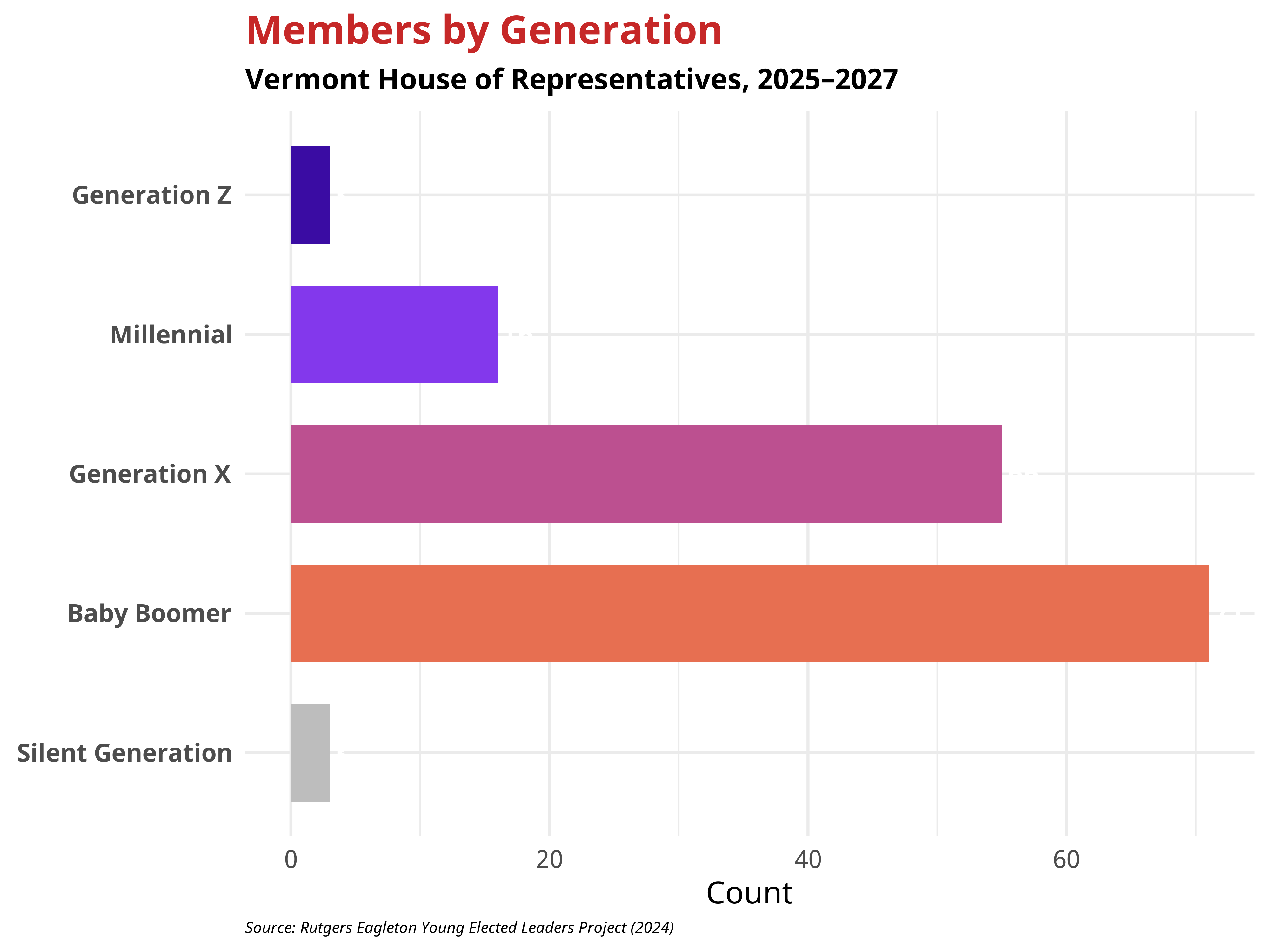
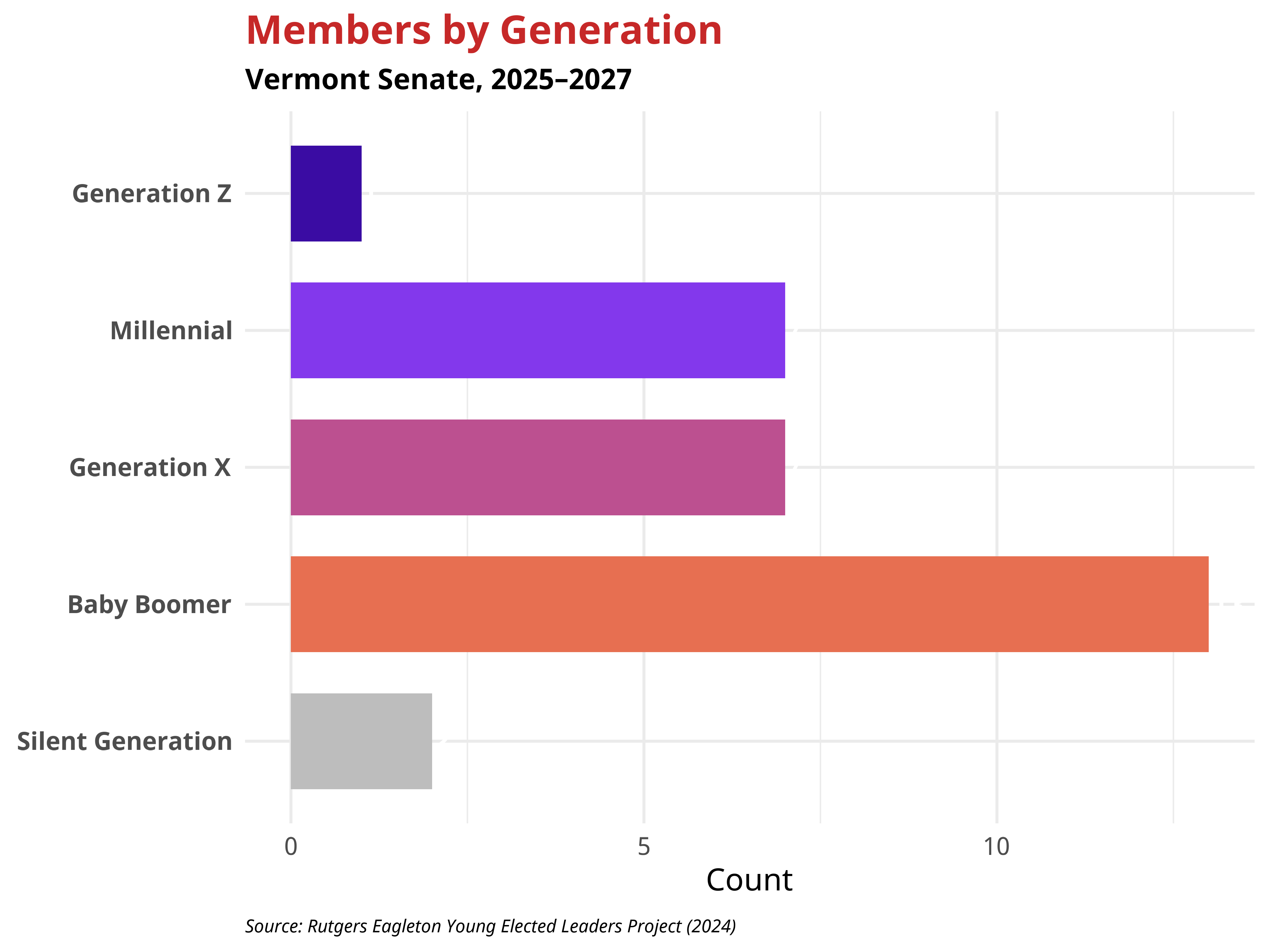
Within the Vermont House of Representatives, most representatives come from the Millennial, Generation X, or the Baby Boomer generations. Scroll below to view the generations represented in the Vermont House of Representatives.
Partisanship in the Vermont House of Representatives
The chart below provides a further breakdown of the current partisan composition of the 2025 Vermont House of Representatives. Each dot represents a single member, colored by both party affiliation and whether the legislator qualifies as a Young Elected Leader (YEL)—defined as age 35 or younger at the time of the election. This format provides a visual snapshot of generational and partisan distribution within the chamber, highlighting how younger legislators are positioned across party lines.
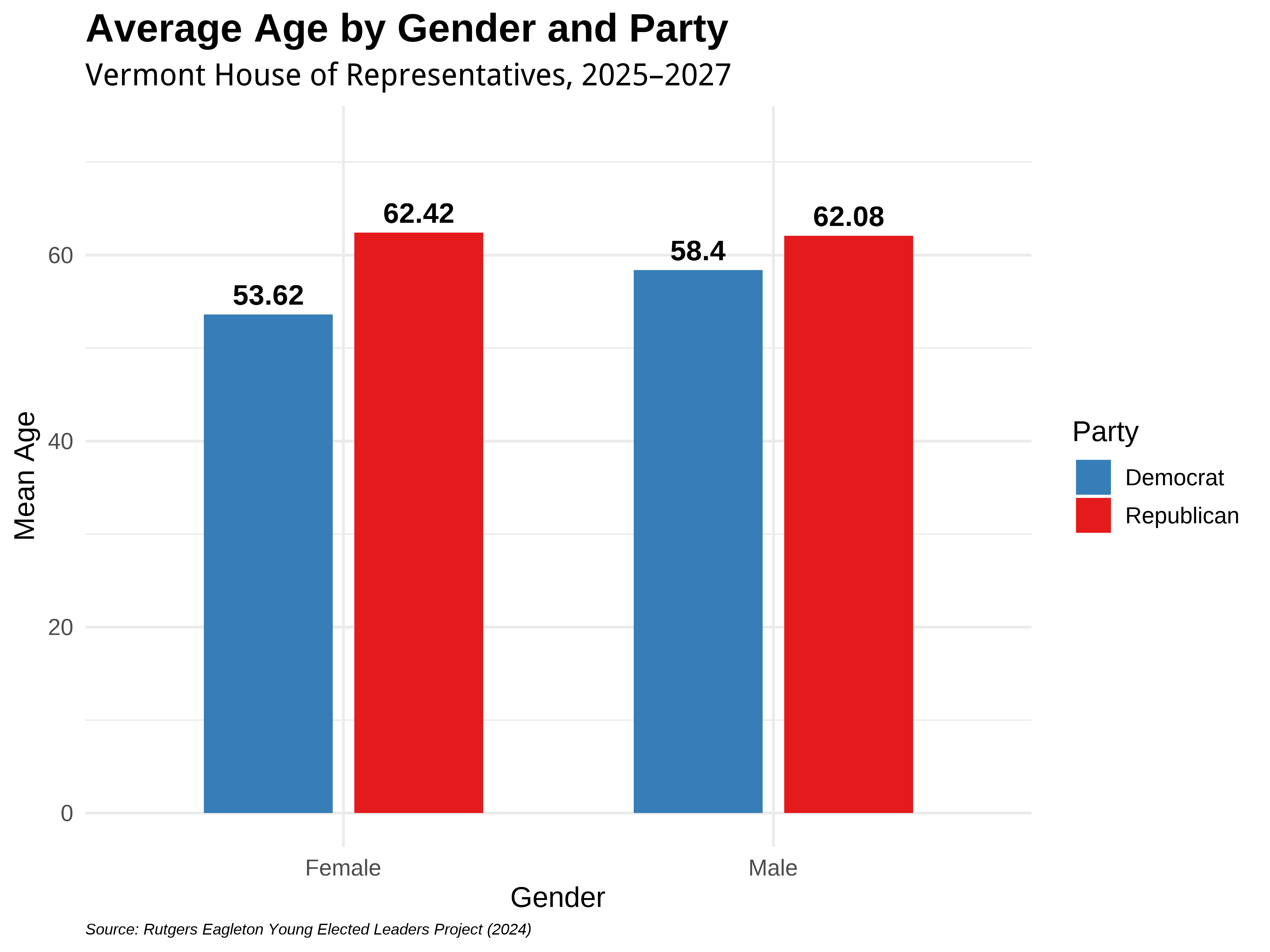
Partisan differences in the Vermont House extend beyond ideology to include notable generational contrasts. As shown in the visual below, Democratic members have an average age of 55.67, while Republicans have a higher average age of 62.17. These disparities may reflect broader patterns in political recruitment, generational turnover, and the types of candidates emerging in recent election cycles. 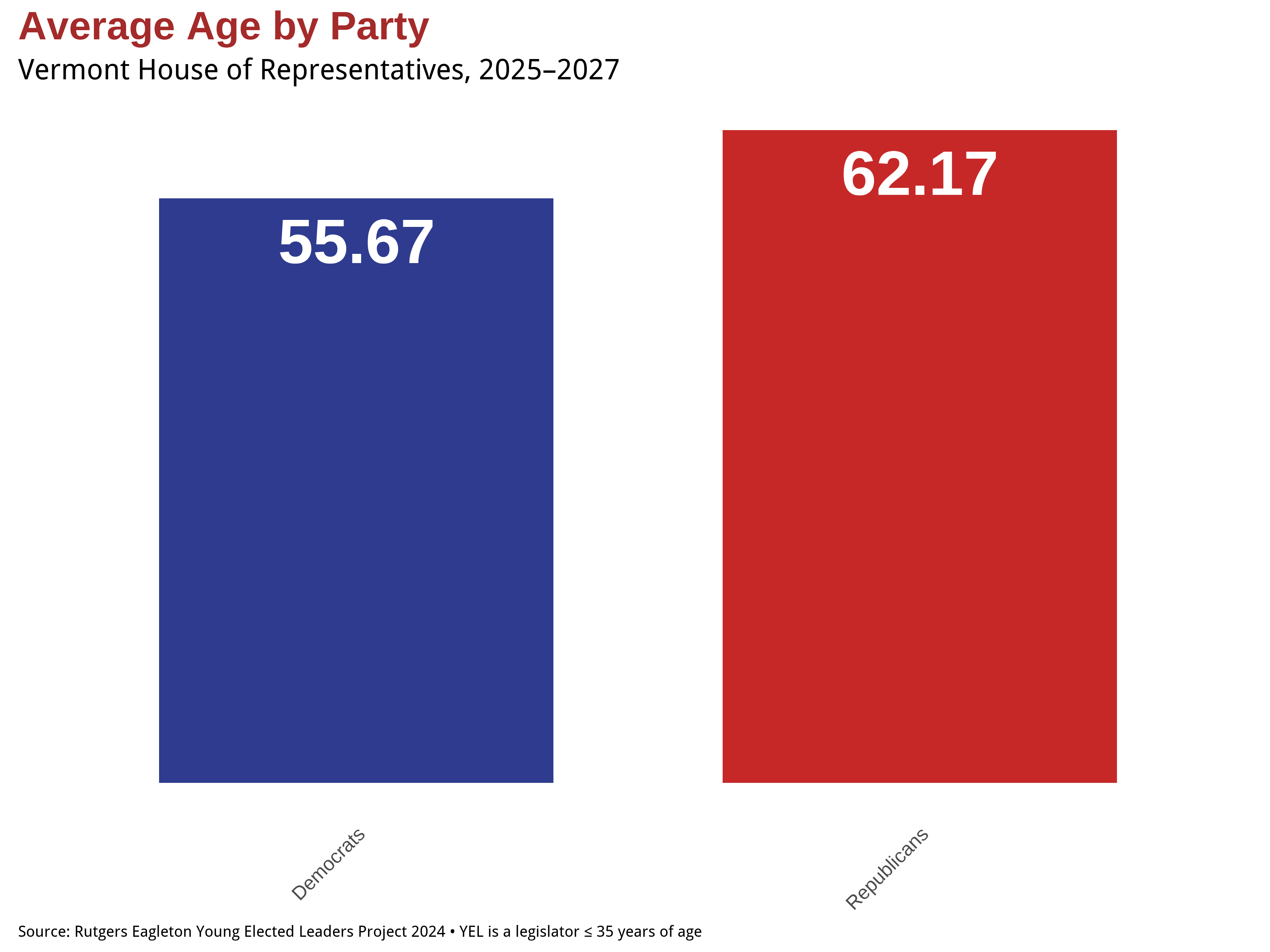
Young Elected Representatives – Vermont House of Representatives
Following the 2024 State Legislative Elections in Vermont, 10 members aged 35 or under were elected to the Vermont House of Representatives. Below are all 10 members, ordered from youngest to oldest, along with information about their local districts and party affiliations.
Young Elected Representatives — Vermont House of Representatives (Age ≤ 35)
| Name | District | Birth Year (Age on Election Day 2024) | First Elected | |
|---|---|---|---|---|
 |
William Greer (D) | District 8 — Fairfield, VT | 2003 (Age 21) | 2018 |
 |
Lucy Boyden (D) | District 57 — Cambridge, VT | 2000 (Age 24) | 2022 |
 |
Edward Waszazak (D) | District 84 — Barre, VT | 1997 (Age 27) | 2024 |
 |
Esme Cole (D) | District 105 — Rutland, VT | 1996 (Age 28) | 2014 |
 |
Ashley R. Bartley (R) | District 46 — Fairfax, VT | 1994 (Age 30) | 2022 |
 |
Philip Jay Hooper (D) | District 63 — Brookfield, VT | 1993 (Age 31) | 2016 |
 |
Ian Goodnow (D) | District 98 — Northfield, VT | 1992 (Age 32) | 2018 |
 |
Heather Surprenant (D) | District 103 — Barnard, VT | 1991 (Age 33) | 2020 |
 |
Chloe Tomlinson (D) | District 38 — Burlington, VT | 1990 (Age 34) | 2024 |
 |
Mary-Katherine Stone (D) | District 31 — Burlington, VT | 1989 (Age 35) | 2022 |
Photos Courtesy of the Vermont House member roster
Gender in the Vermont House of Representatives
The Vermont House of Representatives reflects a range of age and gender dynamics that help shape the composition of the state’s legislative body. In Vermont, men make up a larger share of the chamber than women. Across all members, 60.48% are men, while women make up 55.51%. For female representatives, the average age at the time of the election was 55.51; for men, it was 60.48. Of the 10 Young Elected Leaders, 6 are female, and 4 are male.
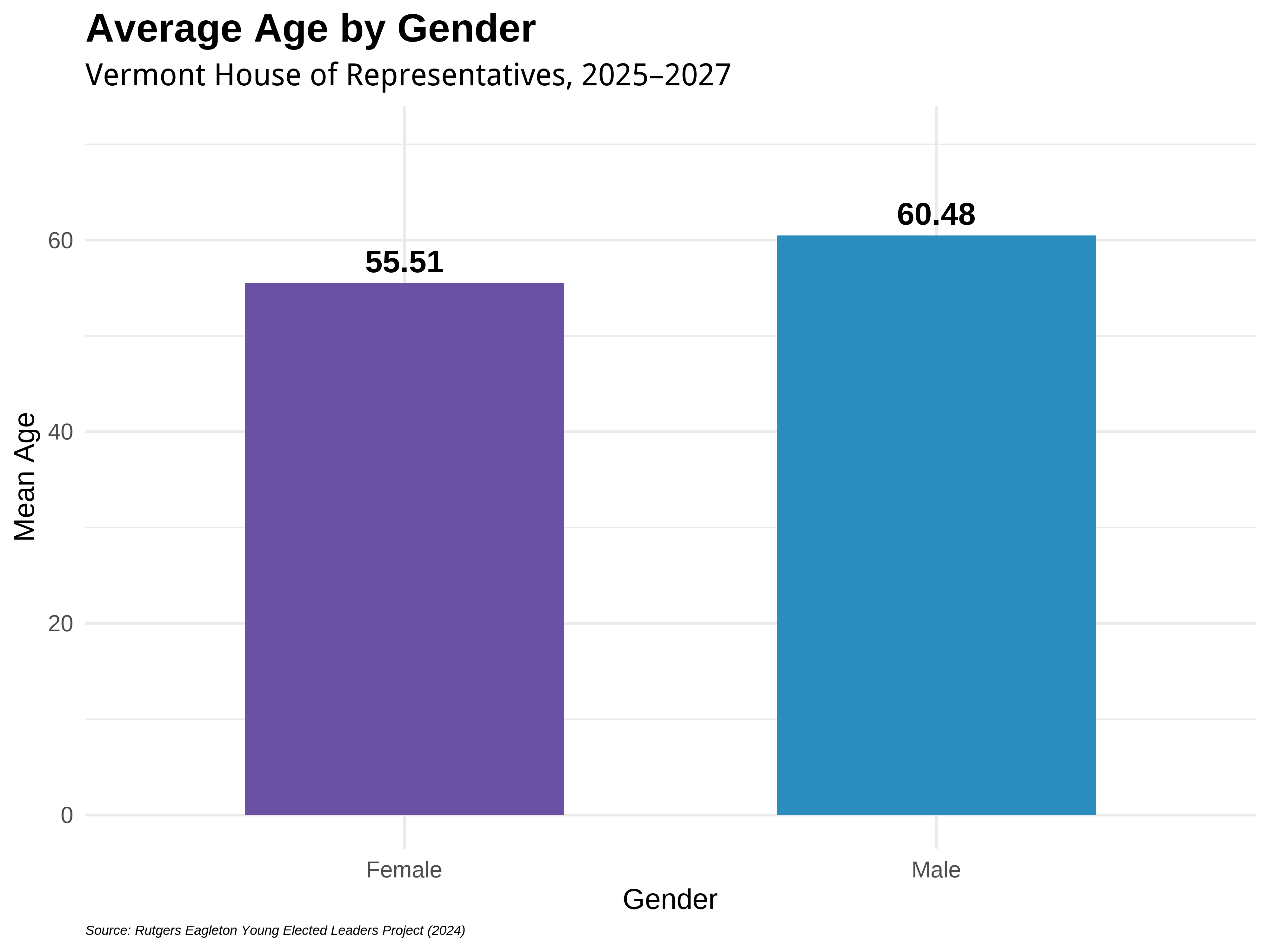
When examining both gender and party affiliation, additional age differences emerge within the Vermont House of Representatives. Republican men and women have a higher average age when compared to Democrats. These patterns show that age representation in the Vermont House of Representatives varies by both gender and partisan alignment, highlighting differing pathways to political office across demographic groups.
Race and Ethnicity in the Vermont House of Representatives
The racial and ethnic composition of the Vermont House of Representatives varies across generations. In 2024, younger cohorts exhibit greater diversity, although the chamber as a whole remains predominantly White. The table below shows the distribution of each generation.
Race and Ethnicity in the Vermont House of Representatives
| Ethnicity | Generation Z 1997–2012 |
Millennial Generation 1981–1996 |
Generation X 1965–1980 |
Boomer Generation 1946–1964 |
Silent Generation 1928–1945 | Full Chamber |
|---|---|---|---|---|---|---|
| Black/African American | 0 (0%) | 2 (12.5%) | 0 (0%) | 1 (1.41%) | 0 (0%) | 3 (2.03%) |
| Hispanic/Latino | 0 (0%) | 0 (0%) | 1 (1.82%) | 0 (0%) | 0 (0%) | 1 (0.68%) |
| Other | 0 (0%) | 0 (0%) | 1 (1.82%) | 0 (0%) | 0 (0%) | 1 (0.68%) |
| Two or More Ethnicities | 0 (0%) | 1 (6.25%) | 0 (0%) | 0 (0%) | 0 (0%) | 1 (0.68%) |
| White/Caucasian | 3 (100%) | 13 (81.25%) | 53 (96.36%) | 70 (98.59%) | 3 (100%) | 142 (95.95%) |
| Total | 3 (2.03%) | 16 (10.81%) | 55 (37.16%) | 71 (47.97%) | 3 (2.03%) | 148 (100%) |
Missing ages for two representatives. The full House of Representatives contains 150 members.
The Vermont Senate
Below is information covering age dynamics in the recently elected Vermont Senate
- The average age of Vermont State Senate members is 57.32 years
- The youngest Senator is Samuel A. Douglass, born in 1998
- The oldest Senator is Randolph D. Brock III, born in 1943
- Two members of the Vermont State Senate are Young Elected Leaders, aged 35 or younger as of Election Day 2024
Young Elected Senators in the Vermont State Senate
Following the 2024 State Legislative Elections in Vermont, two members aged 35 or under were elected to (and currently serve in) the Vermont State Senate.
Young Elected Senator — Vermont Senate (Age ≤ 35)
| Name | District | Birth Year (Age on Election Day 2024) | First Elected | |
|---|---|---|---|---|
 |
Samuel A. Douglass (R) | District 16 — Burlington, VT | 1998 (Age 26) | 2024 |
 |
Becca White (D) | District 83 — Waitsfield, VT | 1994 (Age 30) | 2024 |
Photos courtesy of the Vermont Senate Member Roster.
Partisanship in the Vermont State Senate
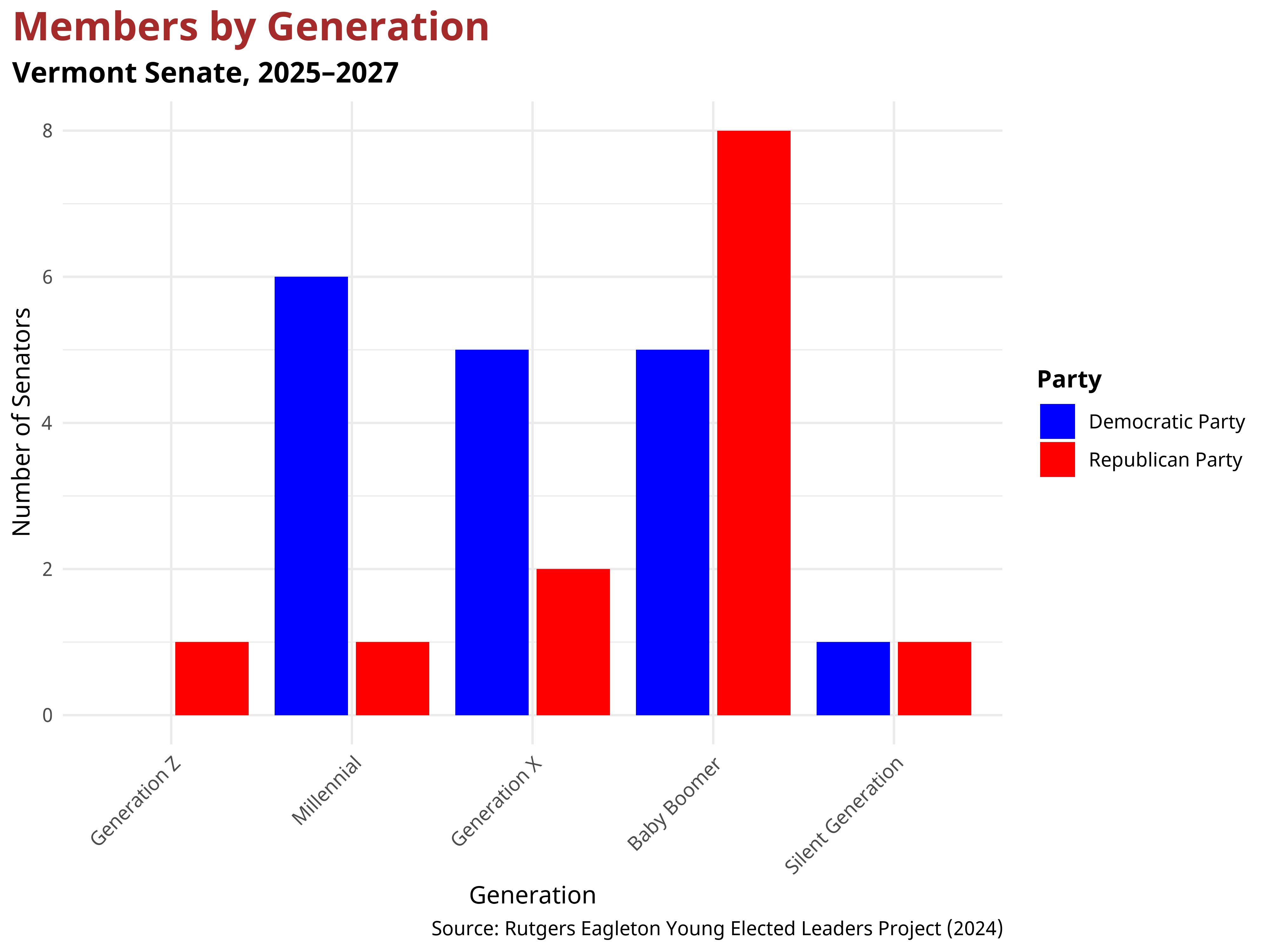
In the Vermont State Senate, 13 senators are Republicans, and 17 are Democrats. The mean age of Democratic state senators after the 2024 election was 54.35, while the mean age of Republican state senators was 61.2. Each generation has a different partisan makeup; overall, the Vermont State Senate is overwhelmingly composed of Baby Boomers and Generation X. Below is the breakdown of party composition by generation in the Vermont State Senate.
Gender in the Vermont Senate
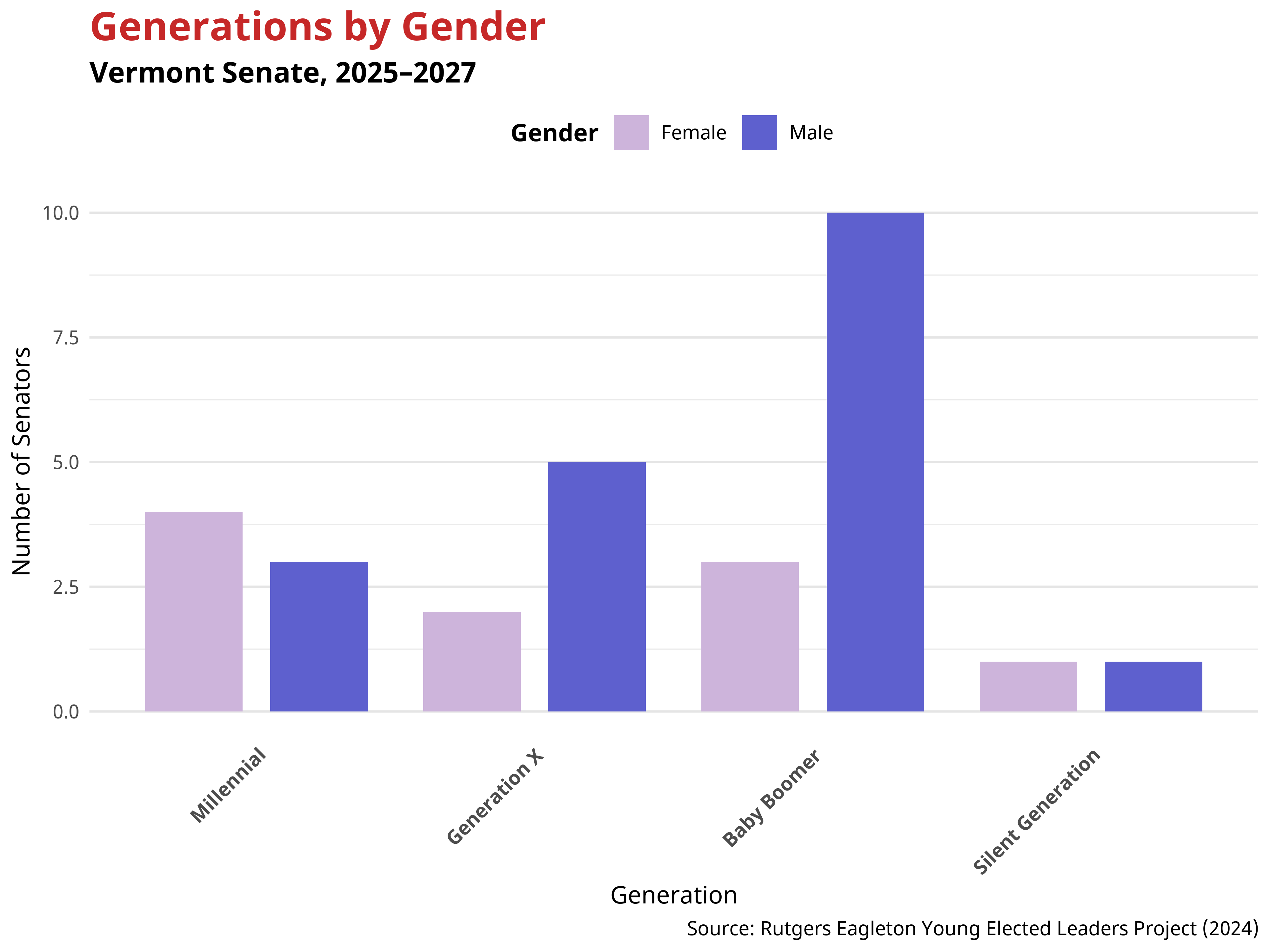
The generational makeup of the Vermont Senate reveals notable gender dynamics. Overall, men are overrepresented across all age groups, especially among older generations. These patterns indicate that gender representation varies across generations, with women being represented in every generational cohort.
Race and Ethnicity in the Vermont Senate
The racial and ethnic composition of the Vermont Senate shows generational variation. The table below presents the distribution by generation.
Generations by Race/Ethnicity in the Vermont Senate
| Ethnicity | Generation Z 1997–2012 | Millennial Generation 1981–1996 |
Generation X 1965–1980 |
Boomer Generation 1946–1964 |
Silent Generation 1928–1945 |
Full Chamber |
|---|---|---|---|---|---|---|
| Black/African American | 0 (0%) | 0 (0%) | 1 (14.29%) | 0 (0%) | 0 (0%) | 1 (3.33%) |
| Indian/Native American | 0 (0%) | 1 (14.29%) | 0 (0%) | 0 (0%) | 0 (0%) | 1 (3.33%) |
| Two or More Ethnicities | 0 (0%) | 1 (14.29%) | 0 (0%) | 0 (0%) | 0 (0%) | 1 (3.33%) |
| White/Caucasian | 1 (100%) | 5 (71.43%) | 6 (85.71%) | 13 (100%) | 2 (100%) | 27 (90%) |
| Total | 1 (3.33%) | 7 (23.33%) | 7 (23.33%) | 13 (43.33%) | 2 (6.67%) | 30 (100%) |
The full Vermont State Senate comprises 30 seats.
Notes
The Young Elected Leaders Project applies the generational categorization of the Pew Research Center:
- Silent Generation: 1928 – 1945
- Baby Boomer Generation: 1946 – 1964
- Generation X: 1965 – 1980
- Millennial Generation: 1981 – 1996
- Generation Z: 1997 – 2012
This analysis is based on data from the most recent state legislative election in Vermont, which took place on November 5th, 2024.
Citation Guideline
In referencing the Young Elected Leaders Project in publication please use the following language: “The Young Elected Leaders Project is housed at the Center for Youth Political Participation at The Eagleton Institute of Politics, Rutgers University – New Brunswick.”
Bibliographic Citation For this document
Author: Young Elected Leaders Project
Corresponding Authors: George D. Quinn, Adil Khan
Year: 2024
Title: Age in the 2025 Vermont General Assembly