

Age in the 2026 New Jersey General Assembly

Photo courtesy of the NJ Spotlight News.
The State of New Jersey held its legislative elections on November 4, 2025, shaping the composition of the New Jersey General Assembly and New Jersey State Senate for the upcoming legislative session. When the newly elected Legislature convenes in January 2026, it will reflect the choices made by voters across the state’s 40 legislative districts. Among all those elected, just two legislators qualify as a Young Elected Leader—defined as being 35 years old or younger on Election Day. In a state of nearly nine million residents and one of the largest full-time legislatures in the country, the presence of two young lawmakers underscores both the rarity and significance of youth representation in New Jersey’s state government. The map below highlights the district represented by these young elected officials within the broader legislative landscape.
New Jersey Demographic Background in the 2025 Election
Preliminary estimates from CIRCLE at Tufts University indicate that 42% of young people aged 18–29 voted in the 2024 election, with turnout surpassing 50% in key battleground states. Nearly 50 million young citizens were eligible to vote nationwide, including over 8 million who turned 18 since the 2022 midterms.
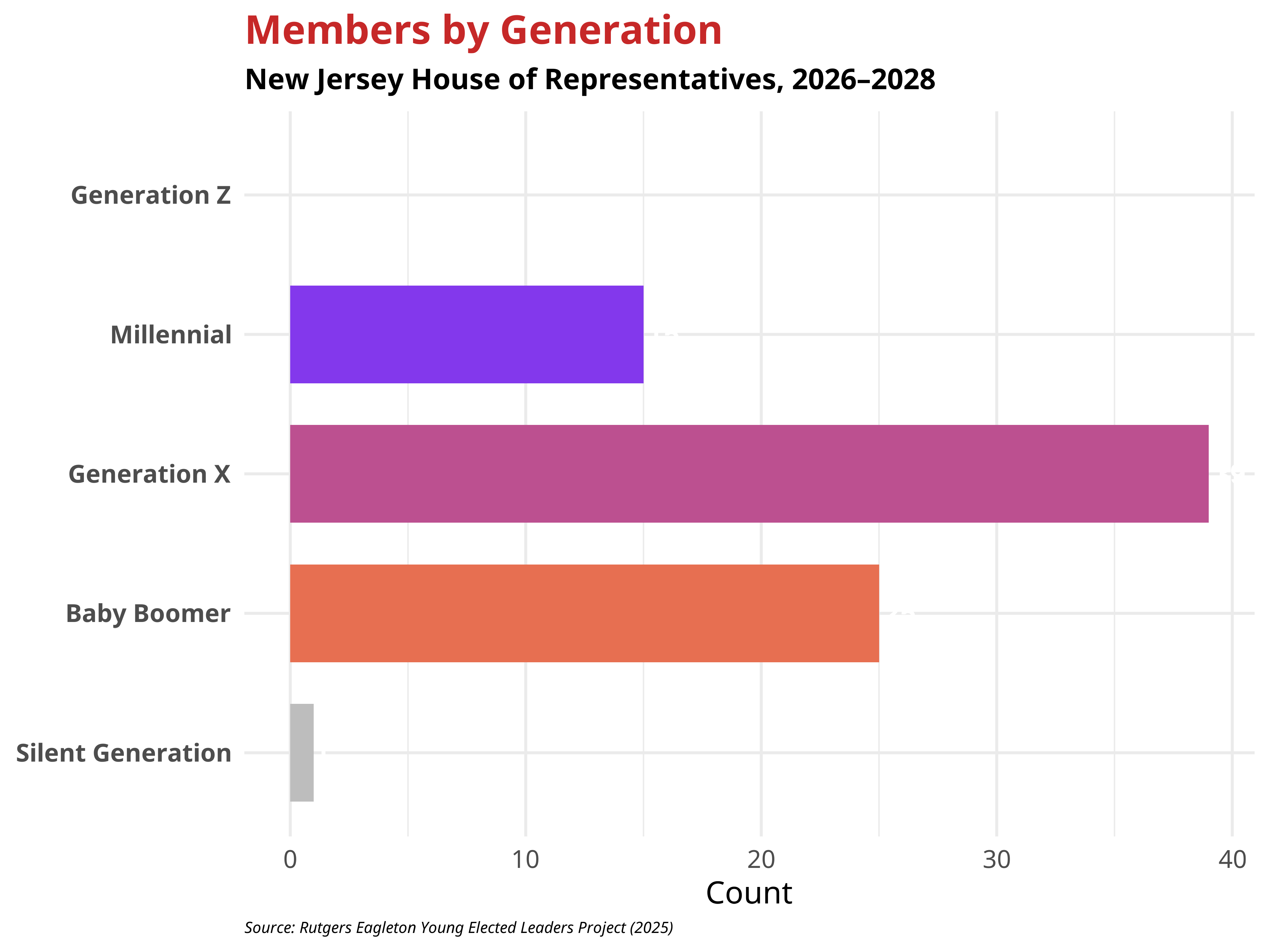
According to the Pew Research Center, Millennials surpassed Baby Boomers in 2020 to become the largest generation in the U.S., making up 31% of the population, followed closely by Boomers at 30.9%. Generation X accounts for 28%, while the Silent Generation makes up just 9.9%.
The New Jersey House of Representatives 2026 Legislative Session
Below is information covering age dynamics in the recently elected members of the New Jersey House of Representatives
- The average age among New Jersey House members was 54.13 years
- The youngest Representative, Cody Daniel Miller, was born in 1991
- The oldest Representative, Cleopatra G. Tucker, was born in 1943
- 2 Representatives are Young Elected Leaders, age 35 or younger as of Election Day 2025
Generational Breakdown
Within the New Jersey House of Representatives, most representatives come from the Millennial, Generation X, or the Baby Boomer generations. Scroll below to view the generations represented in the New Jersey House of Representatives.
Partisanship in the New Jersey House of Representatives
The chart below provides a further breakdown of the current partisan composition of the 2026 New Jersey House of Representatives. Each dot represents a single member, colored by both party affiliation and whether the legislator qualifies as a Young Elected Leader (YEL)—defined as age 35 or younger at the time of the election. This format provides a visual snapshot of generational and partisan distribution within the chamber, highlighting how younger legislators are positioned across party lines.
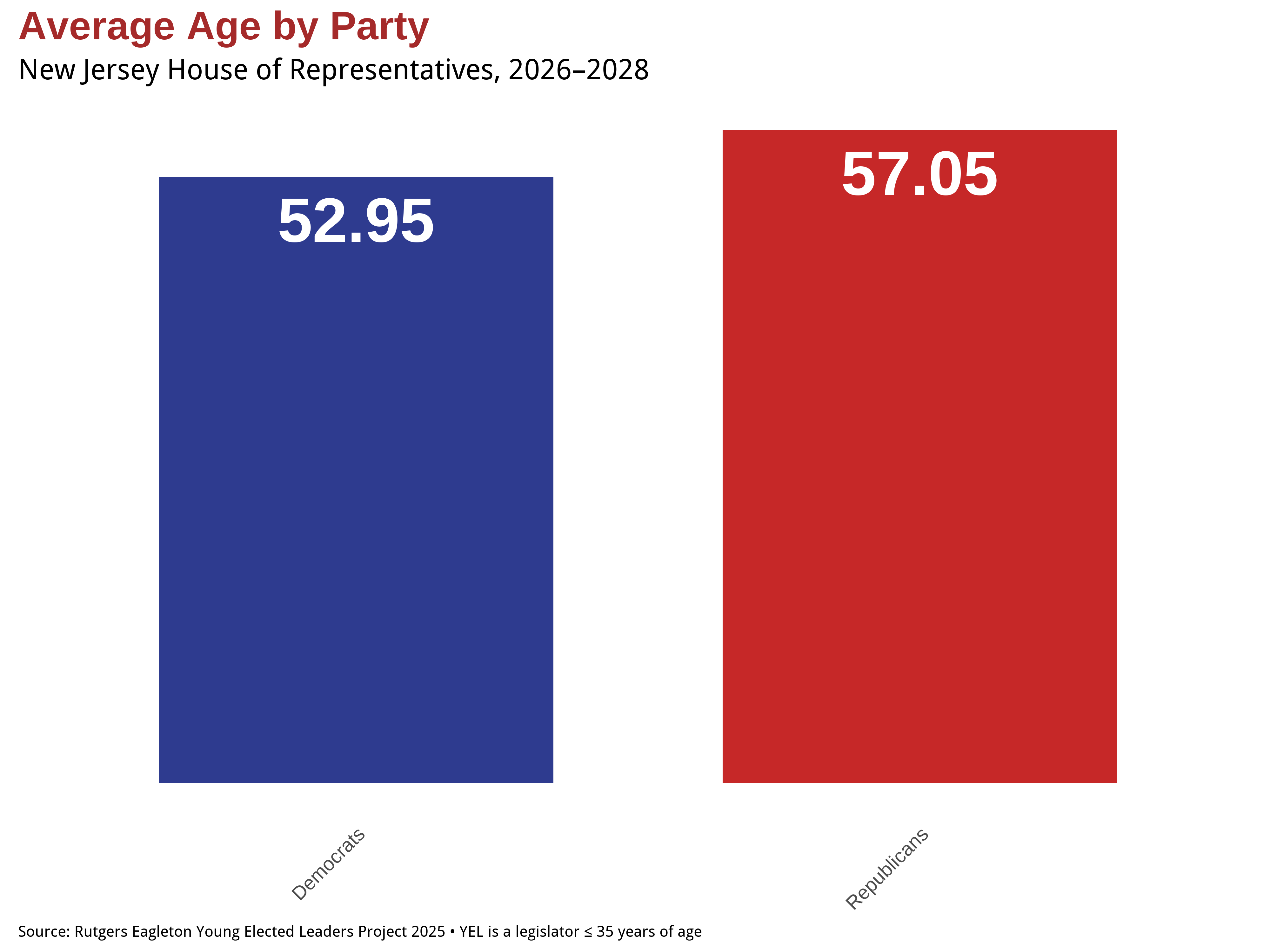
Partisan differences in the New Jersey General Assembly extend beyond ideology to include clear generational contrasts. As illustrated in the visual below, Democratic members have an average age of 52.95, while Republican members have a higher average age of 57.05. This roughly four-year gap highlights meaningful differences in generational representation between the parties and may reflect broader trends in candidate recruitment, leadership pipelines, and generational turnover within New Jersey politics.
Young Elected Representatives — New Jersey House of Representatives (Age ≤ 35)
Following the 2025 State Legislative Elections in New Jersey, two members aged 35 or under were elected to the New Jersey House of Representatives. Below are both members, ordered from youngest to oldest, along with information about their local districts and party affiliations.
| Name | District | Birth Year (Age on Election Day 2025) | First Elected | |
|---|---|---|---|---|
 |
Cody Daniel Miller (D) | District 4 — Camden, NJ | 1991 (Age 34) | 2023 |
 |
William B. Sampson IV (D) | District 31 — Hudson County, NJ | 1989 (Age 35) | 2021 |
Photos Courtesy of the New Jersey House member roster
Gender in the New Jersey House of Representatives
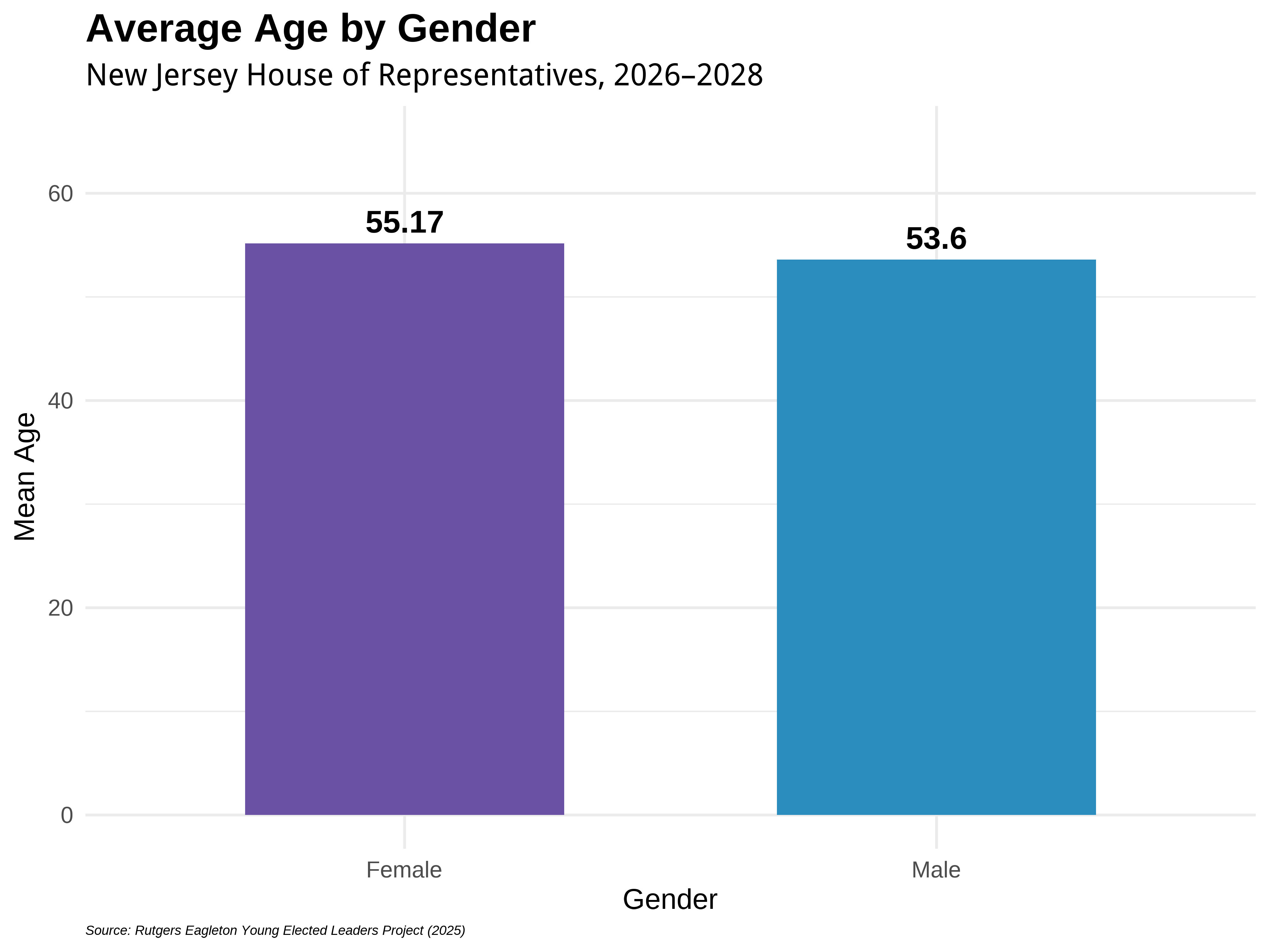
The New Jersey General Assembly reflects a range of age and gender dynamics that shape the composition of the state’s legislative body. In the current chamber, men make up 66.25% of members, while women account for 33.75%. The average age at the time of the election was 55.17 for female legislators and 53.6 for male legislators. Among the two Young Elected Leaders elected in 2025, both are male, highlighting how youth representation and gender representation intersect within the Assembly.
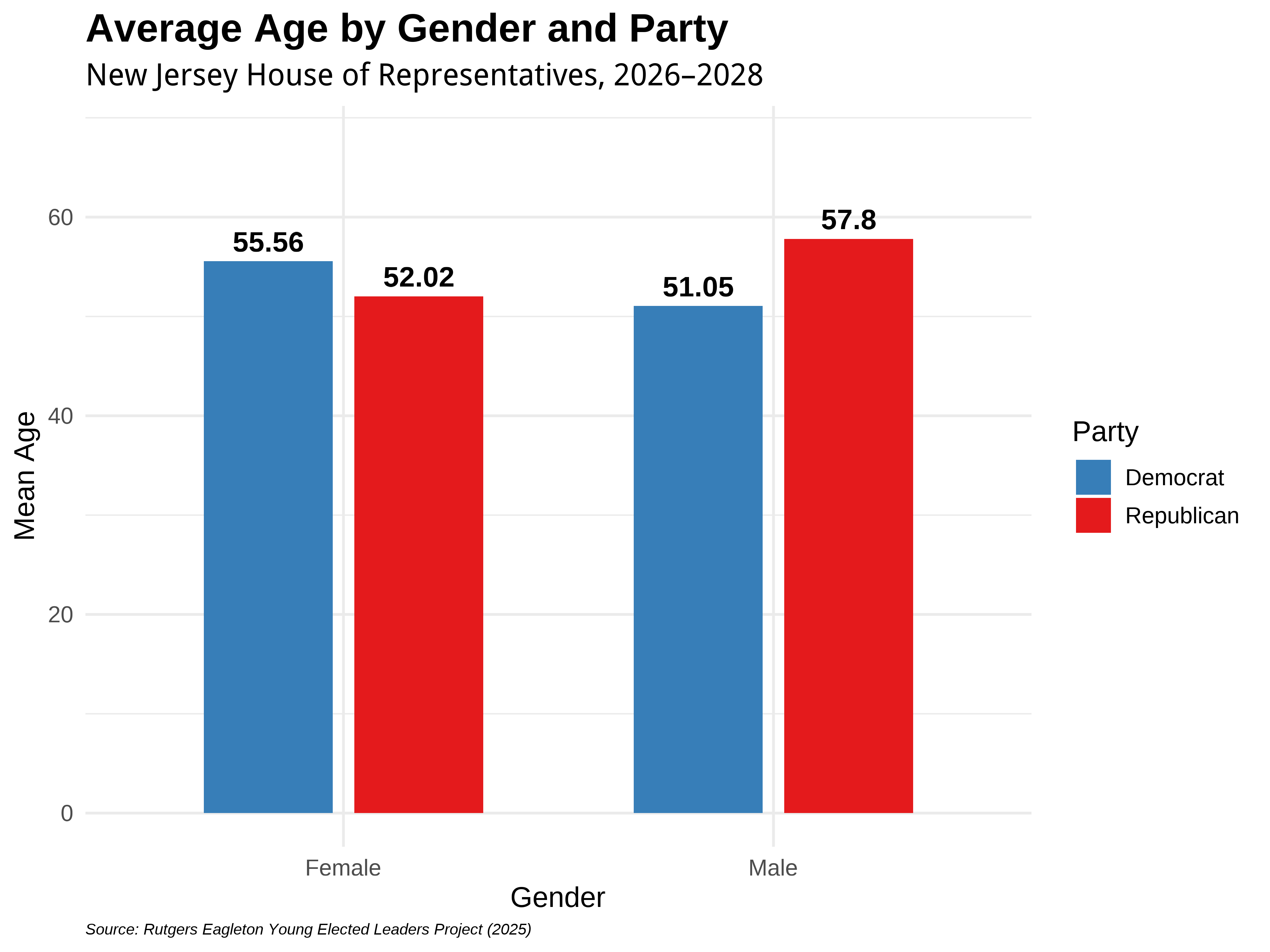
When examining both gender and party affiliation, additional age differences emerge within the New Jersey General Assembly. Among women legislators, Democratic members have an average age of 55.56, compared to 52.02 for Republican women. Among men, however, the pattern reverses: Republican men have the highest average age at 57.8, while Democratic men average 51.05. These differences illustrate how age representation in the Assembly varies across both gender and partisan lines, suggesting distinct generational dynamics within each party’s legislative cohort.
Race and Ethnicity in the New Jersey House of Representatives
The racial and ethnic composition of the 2025 New Jersey General Assembly varies across generational cohorts. While the chamber overall remains predominantly White, younger legislators reflect comparatively greater diversity. Millennial and Generation X members include broader representation across racial and ethnic groups, including Black/African American, Hispanic/Latino, Asian/Pacific American, and Indian/Native American legislators.
Race and Ethnicity in the New Jersey House of Representatives
| Ethnicity | Millennial Generation 1981–1996 |
Generation X 1965–1980 |
Boomer Generation 1946–1964 |
Silent Generation 1928–1945 | Full Chamber |
|---|---|---|---|---|---|
| Asian/Pacific American | 1 (6.67%) | 2 (5.13%) | 0 (0%) | 0 (0%) | 3 (3.75%) |
| Black/African American | 2 (13.33%) | 6 (15.38%) | 2 (8%) | 1 (100%) | 11 (13.75%) |
| Hispanic/Latino | 0 (0%) | 7 (17.95%) | 2 (8%) | 0 (0%) | 9 (11.25%) |
| Indian/Native American | 1 (6.67%) | 0 (0%) | 0 (0%) | 0 (0%) | 1 (1.25%) |
| Other | 0 (0%) | 1 (2.56%) | 0 (0%) | 0 (0%) | 1 (1.25%) |
| White / Caucasian | 11 (73.33%) | 23 (58.97%) | 21 (84%) | 0 (0%) | 55 (68.75%) |
| Total (Percent of Chamber) | 15 (18.75%) | 39 (48.75%) | 25 (31.25%) | 1 (1.25%) | 80 (100%) |
The full New Jersey House of Representatives consists of 80 members
The New Jersey Senate
Below is information covering age dynamics in the recently elected New Jersey Senate
- The average age of New Jersey State Senators is 61.23 years
- The youngest Senator is Britnee N. Timberlake, born in 1986
- The oldest Senator is Shirley K. Turner, born in 1941
- Zero members of the New Jersey State Senate qualify as Young Elected Leaders, age 35 or younger on Election Day 2025.
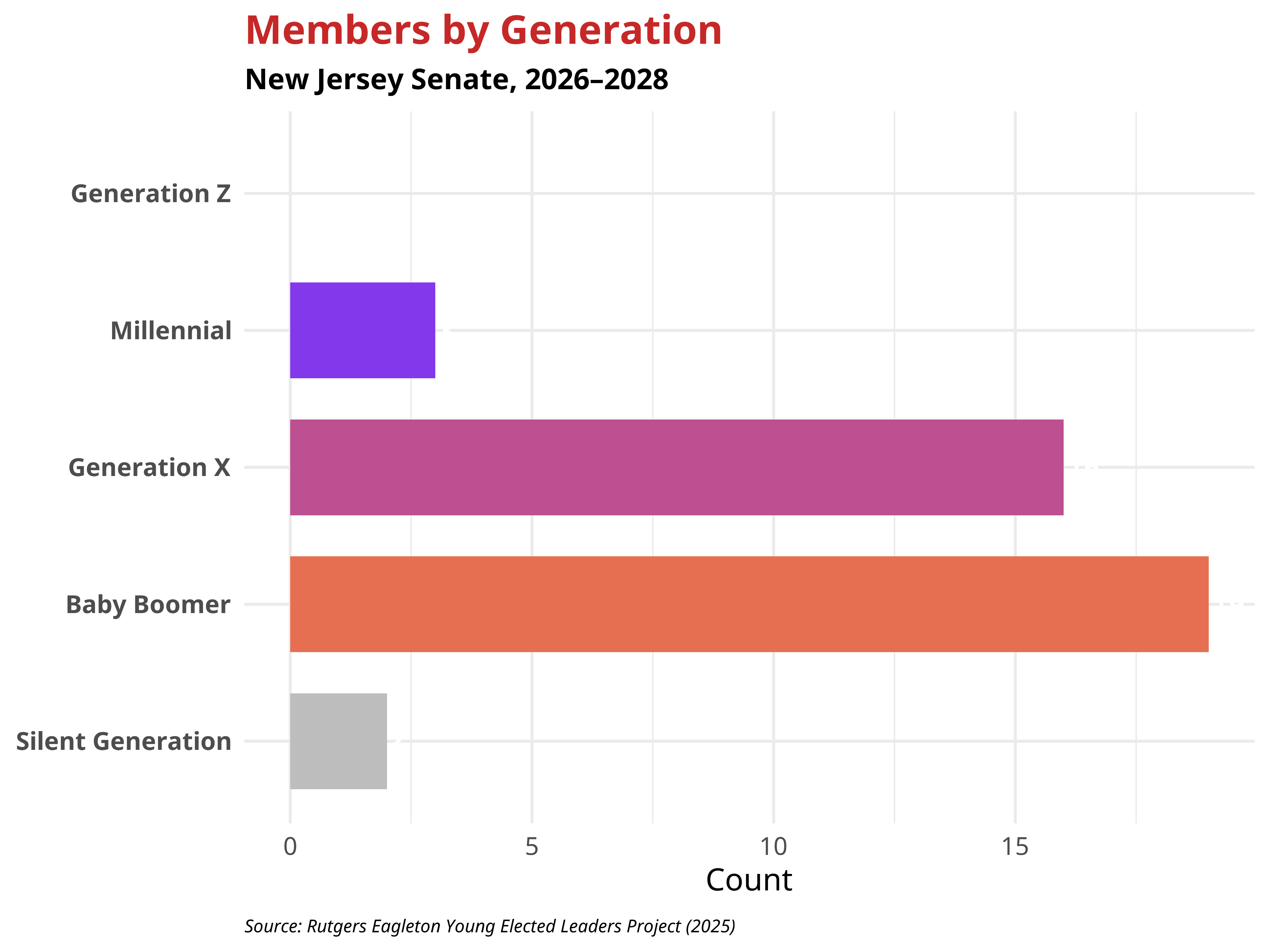
Young Elected Senators in the New Jersey State Senate
Following the 2025 State Legislative Elections in New Jersey, there are no members aged 35 or under elected to (and currently serving in) the New Jersey State Senate.
Partisanship in the New Jersey State Senate
In the New Jersey State Senate, 15 senators are Republicans, and 25 are Democrats. Following the 2025 election, the average age of Democratic senators was 60.99, while Republican senators had a slightly higher average age of 61.62, reflecting only a modest partisan age gap. Despite this similarity, the chamber’s overall generational profile remains concentrated among Baby Boomers and Generation X members, with little to no representation from younger cohorts. The breakdown below illustrates how party affiliation is distributed across generations within the New Jersey State Senate.
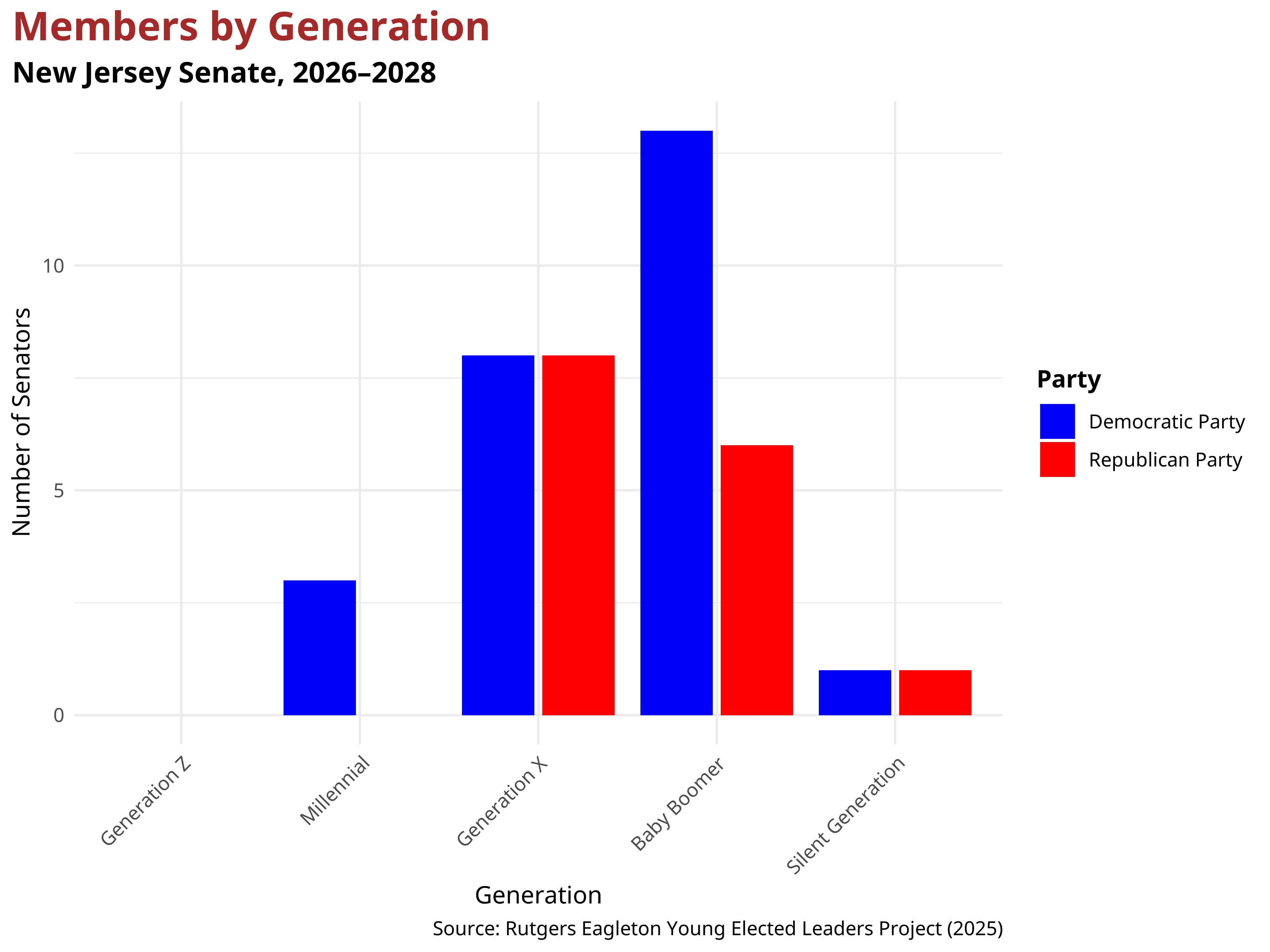
Gender in the New Jersey Senate
The generational makeup of the New Jersey Senate reveals notable gender dynamics. Overall, men are overrepresented across all age groups, especially among older generations. These patterns indicate that gender representation varies across generations, with women being represented in every generational cohort.
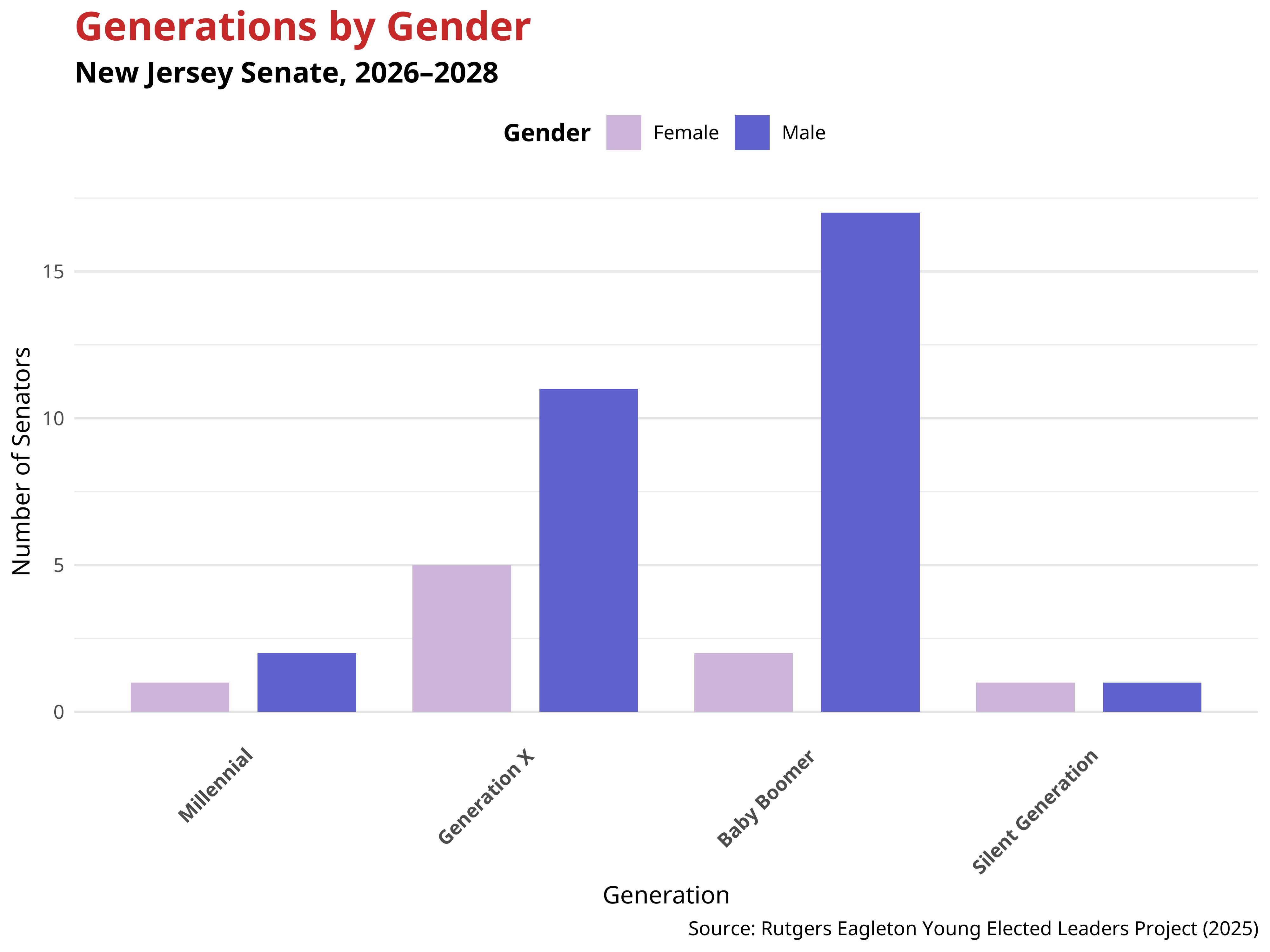
Race and Ethnicity in the New Jersey Senate
The racial and ethnic composition of the New Jersey State Senate varies across generations, though the chamber overall remains predominantly White. Younger cohorts, particularly Millennials, reflect greater racial and ethnic diversity, with representation across multiple racial groups. Generation X members also include a mix of racial and ethnic backgrounds, though White legislators comprise a majority of that cohort. Among Baby Boomers and members of the Silent Generation, the Senate is less diverse, with White senators making up a larger share of those generations. While signs of demographic change are visible among younger senators, older generations continue to shape the chamber’s overall racial and ethnic profile.
Generations by Race/Ethnicity in the New Jersey Senate
| Ethnicity | Millennial Generation 1981–1996 |
Generation X 1965–1980 |
Boomer Generation 1946–1964 |
Silent Generation 1928–1945 | Full Chamber |
|---|---|---|---|---|---|
| Asian/Pacific American | 1 (33.33%) | 0 (0%) | 0 (0%) | 0 (0%) | 1 (2.5%) |
| Black/African American | 1 (33.33%) | 3 (18.75%) | 2 (10.53%) | 1 (50%) | 7 (17.5%) |
| Hispanic/Latino | 0 (0%) | 2 (12.5%) | 2 (10.53%) | 0 (0%) | 4 (10%) |
| Other | 1 (33.33%) | 0 (0%) | 0 (0%) | 0 (0%) | 1 (2.5%) |
| White/Caucasian | 0 (0%) | 11 (68.75%) | 15 (78.95%) | 1 (50%) | 27 (67.5%) |
| Total (Percent of Chamber) | 3 (7.5%) | 16 (40%) | 19 (47.5%) | 2 (5%) | 40 (100%) |
The full New Jersey State Senate comprises 40 seats.
Notes
The Young Elected Leaders Project applies the generational categorization of the Pew Research Center:
- Silent Generation: 1928 – 1945
- Baby Boomer Generation: 1946 – 1964
- Generation X: 1965 – 1980
- Millennial Generation: 1981 – 1996
- Generation Z: 1997 – 2012
This analysis is based on data from the most recent state legislative election in New Jersey, which took place on November 4th 2025.
Citation Guideline
In referencing the Young Elected Leaders Project in publication please use the following language: “The Young Elected Leaders Project is housed at the Center for Youth Political Participation at The Eagleton Institute of Politics, Rutgers University – New Brunswick.”
Bibliographic Citation For this document
Author: Young Elected Leaders Project
Corresponding Authors: George D. Quinn, Adil Khan
Year: 2025
Title: Age in the 2026 New Jersey General Assembly